Focus
ANTHROPIC CERTIFICATION STUDY GUIDE
CCAR-P practice questions.
Prepare with a clearer plan.
Validates ability to own production Claude systems end to end, including solution design and architecture, enterprise integration, evaluation and optimization, governance and risk management, and stakeholder lifecycle management.
Download Revizo
What to know about CCAR-P.
Validates ability to own production Claude systems end to end, including solution design and architecture, enterprise integration, evaluation and optimization, governance and risk management, and stakeholder lifecycle management.
- Format
- 63 scenario-based multiple-choice and multiple-response questions
- Duration
- 120 minutes
- Passing score
- 720/1000
- Recommended experience
- 3+ years of systems architecture or platform engineering experience and 6+ months delivering production Claude or LLM solutions
Exam details are based on the available Anthropic catalogue information. Confirm current requirements with the exam provider before booking.
Prepare CCAR-P as an end-to-end architecture exam.
The listed certification goes beyond model use: it connects solution design, enterprise integration, evaluation, optimisation, governance and stakeholder management. Revise those decisions as one system rather than isolated features.
Focus
Evaluation and optimisation
Measure behaviour, use feedback and improve the solution over its lifecycle.Focus
Governance and risk
Balance reliability, safety, access, policy and stakeholder requirements.CCAR-P is a professional architecture path for production ownership. It is not a substitute for the provider's current objectives, registration guidance or policies.
How to prepare for CCAR-P.
Use the provider's current objectives as your source of truth, then organise your Revizo sessions around Claude, production AI-system design and the practical scenarios named in the certification. The CCAR-P exam is listed as 63 scenario-based multiple-choice and multiple-response questions; your starting point should reflect 3+ years of systems architecture or platform engineering experience and 6+ months delivering production Claude or LLM solutions.
Map the official objectives.
Read the current Anthropic objectives and make a short list of the areas you need to revisit before booking CCAR-P.
Practise one area at a time.
Select CCAR-P in Revizo and use focused question sessions to test one topic or decision type at a time, rather than relying on a single long cram session.
Review, then repeat.
Use your results to return to incorrect answers, revisit the official material behind them and repeat short CCAR-P practice sessions until the gaps are clearer.
FREE PRACTICE PREVIEW
Read the first 20
CCAR-P questions.
Review each question, its correct answer and any available source explanation before continuing your certification study in Revizo.
FIRST 20 QUESTIONS
Answers & available explanations
QUESTION 1
HOTSPOT -
You are a solution architect evaluating candidate use cases for a Claude-based program.
For each scenario, select yes if Claude is appropriate as the primary solution at the architectural level Otherwise, select no.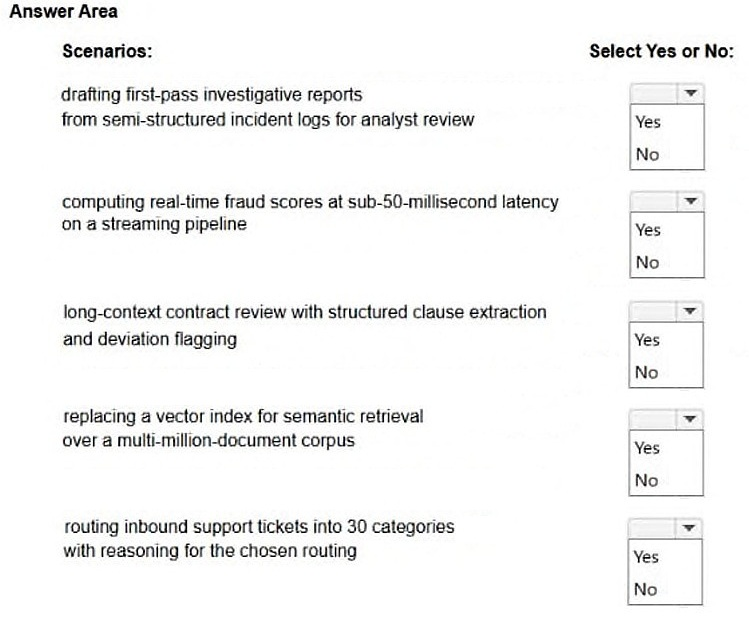
Item 1
Item 2
Item 3
Item 4
Item 5
Show answer & explanation
Correct answer: Item 1: A · Item 2: B · Item 3: A · Item 4: B · Item 5: A
ExplanationClaude is architecturally appropriate for language-heavy reasoning, drafting, classification with explanations, and long-document analysis. It is not the primary solution for sub-50ms streaming scoring pipelines (traditional ML/rules) or for replacing a vector database/index layer used for retrieval infrastructure. See Anthropic solution patterns for augmented LLM vs. workflow vs. agentic designs.
QUESTION 2
A managed agent deployment for claims triage has grown from 6 tools to 34 tools over 18 months as product teams added capabilities. Triage accuracy has declined from 91 percent to 78 percent, and average tool selection latency has increased by 2.3 seconds. A junior engineer has proposed adding a tool router agent in front of the current agent to filter the tool list per request.
Which two findings should you present to justify capability decomposition before adding the router? (Choose two.)
Each correct answer presents part of the solution.
Show answer & explanation
Correct answer: B, D
ExplanationDecompose when tools span distinct workflow domains (four domains) and adding a router introduces another model call per request without reducing tool sprawl. Unused or overlapping tools are hygiene issues, not structural decomposition drivers. https://www.anthropic.com/engineering/building-effective-agents
QUESTION 3
HOTSPOT -
You are reviewing a peer’s end-to-end design for a Claude-based platform expected to scale to thousands of concurrent users.
For each statement, indicate yes if the statement reflects a sound architectural practice. Otherwise, select no.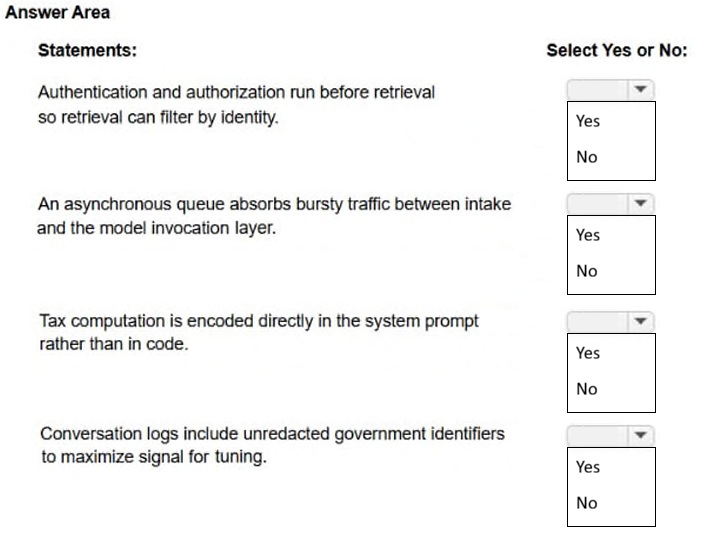
Item 1
Item 2
Item 3
Item 4
Show answer & explanation
Correct answer: Item 1: A · Item 2: A · Item 3: B · Item 4: B
ExplanationEnforce authN/authZ before retrieval for tenant-safe filtering; decouple bursty intake with queues to protect latency and quotas. Business rules like tax calculation belong in deterministic code, not prompts. Logs must redact sensitive identifiers for privacy and compliance.
QUESTION 4
You are comparing patterns for a batch document-classification job that follows fixed steps: extract metadata, classify, summarize, and persist.
Which pattern is the best fit and why?
Show answer & explanation
Correct answer: A
Explanation
QUESTION 5
A platform team operates a self-hosted multi-agent system on Kubernetes that orchestrates seven specialized agents for invoice processing. The team spends approximately 40 percent of engineering capacity on infrastructure maintenance, message bus reliability, and agent state recovery. The CFO has asked you to evaluate moving to managed agent infrastructure to reclaim engineering capacity. The security officer requires that all customer financial data remain within an approved network boundary.
Which factor should most heavily influence your recommendation?
Show answer & explanation
Correct answer: D
ExplanationWhen security mandates an approved network boundary, data residency/enclave constraints outweigh engineering toil savings from managed infrastructure. https://docs.anthropic.com/en/docs/about-claude/glossary
QUESTION 6
You are selecting a pattern for a compliance Q&A assistant that must answer policy questions with citations to the authoritative internal source set. Latency, cost, and audit predictability are prioritized.
Which pattern is the best fit?
Show answer & explanation
Correct answer: C
ExplanationCompliance Q&A with citations favors retrieval-augmented generation over the authoritative internal corpus, not full-corpus stuffing or uncontrolled web browsing. https://docs.anthropic.com/en/docs/build-with-claude/overview
QUESTION 7
You are a solution architect designing a Claude-based assistant with access to 60 internal tools across multiple business domains. Loading every tool definition on every request increases token usage and time to first response.
Which design pattern best addresses this issue without sacrificing capability breadth?
Show answer & explanation
Correct answer: B
Explanation
QUESTION 8
HOTSPOT -
You are sequencing decomposed components in an invoice-processing pipeline.
For each of the decomposed components, select the execution layer it belongs to: “Pre-Processing”, “Model Stage”, or “Post-Processing”.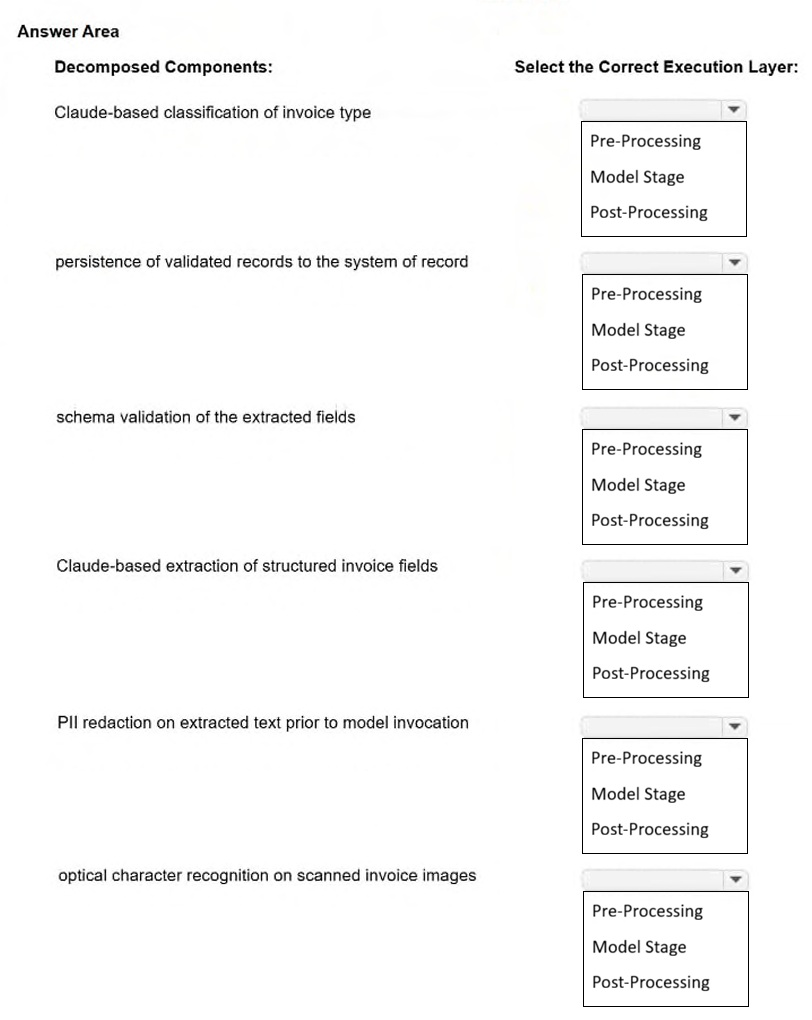
Item 1
Item 2
Item 3
Item 4
Item 5
Item 6
Show answer & explanation
Correct answer: Item 1: B · Item 2: C · Item 3: C · Item 4: B · Item 5: A · Item 6: A
ExplanationOCR and PII redaction are pre-processing before model calls; Claude classification/extraction belong in the model stage; schema validation and persistence to the system of record are post-processing after model output.
QUESTION 9
You are reviewing a customer-support agent’s configuration. Each candidate tool falls into one of four categories:
(1) required to complete defined tasks
(2) frequently used and reduces hand-offs
(3) occasionally useful for unrelated work
(4) speculative future utility
Which categories should typically remain in the agent configuration?
Show answer & explanation
Correct answer: B
Explanation
QUESTION 10
HOTSPOT -
You are classifying token-management tactics by where in the request lifecycle each tactic applies.
For each of the tactics, select where in the request lifecycle each tactic applies: “Input Preparation”, “Prompt Construction”, or “Output Handling”.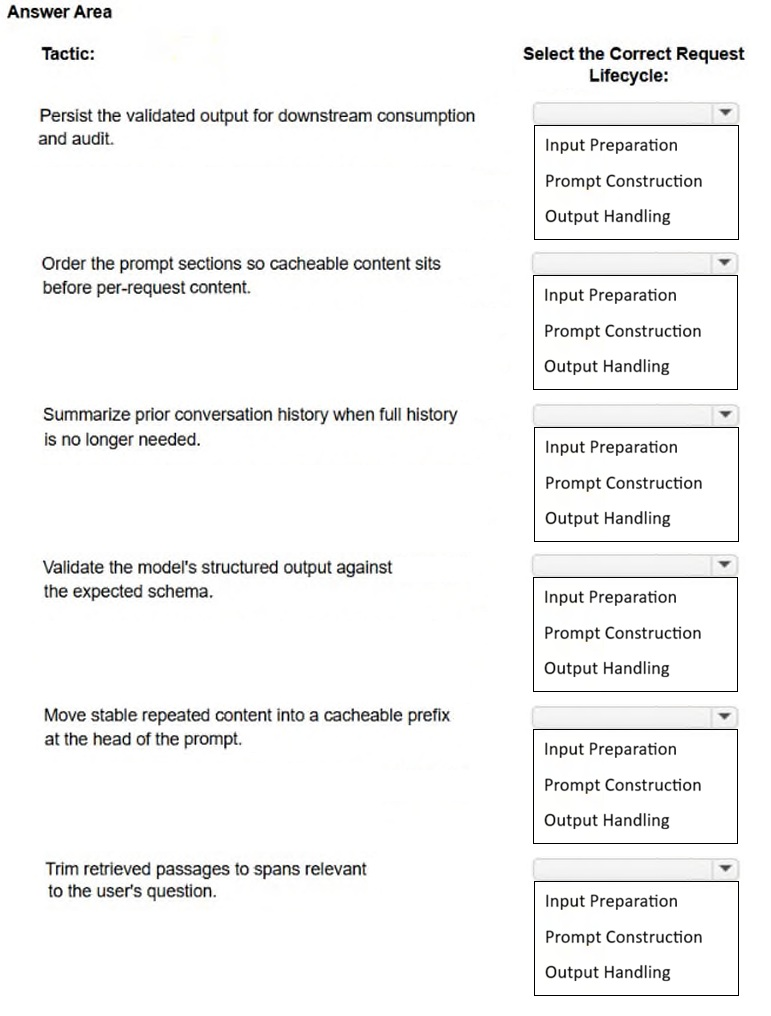
Item 1
Item 2
Item 3
Item 4
Item 5
Item 6
Show answer & explanation
Correct answer: Item 1: C · Item 2: B · Item 3: A · Item 4: C · Item 5: B · Item 6: A
ExplanationInput preparation trims/summarizes context; prompt construction orders cacheable prefixes and static sections; output handling validates, persists, and routes finalized model outputs.
QUESTION 11
You are reviewing a peer’s draft system prompt that contains contradictory instructions: one section says to never speculate beyond the supplied source, and another says to confidently fill in any gaps.
Which response is most appropriate?
Show answer & explanation
Correct answer: B
ExplanationConflicting system instructions produce unpredictable behavior; Anthropic prompt guidance emphasizes clear, consistent instructions and explicit context rather than opposing mandates. The architect should send the draft back with a single policy grounded in provided sources and transparent uncertainty. See https://docs.anthropic.com/en/docs/build-with-claude/prompt-engineering/be-clear-and-direct
QUESTION 12
A document analysis service processes legal filings averaging 80,000 tokens each. Each filing is queried by attorneys an average of 14 times during a case. The current architecture sends the full filing on every query. The CFO has asked you to reduce per-query costs while preserving response quality. The security officer requires that filing contents not be stored outside Fabrikam’s tenancy.
Which optimization approach should you recommend?
Show answer & explanation
Correct answer: B
ExplanationThe workload resends the same ~80k-token document across ~14 queries per case; prompt caching reuses a stable prefix so later calls pay primarily for new question tokens while preserving full-document context under commercial data handling. Place static filing content before cache breakpoints and variable questions after. See https://docs.anthropic.com/en/docs/build-with-claude/prompt-caching
QUESTION 13
HOTSPOT -
You are classifying chunking strategies by the corpus type each is best suited to.
For each chunking strategy, select where in the request lifecycle each applies: “Long Structured Documents”, “Heterogeneous Short Records”, or “Code or Hierarchical Specs”.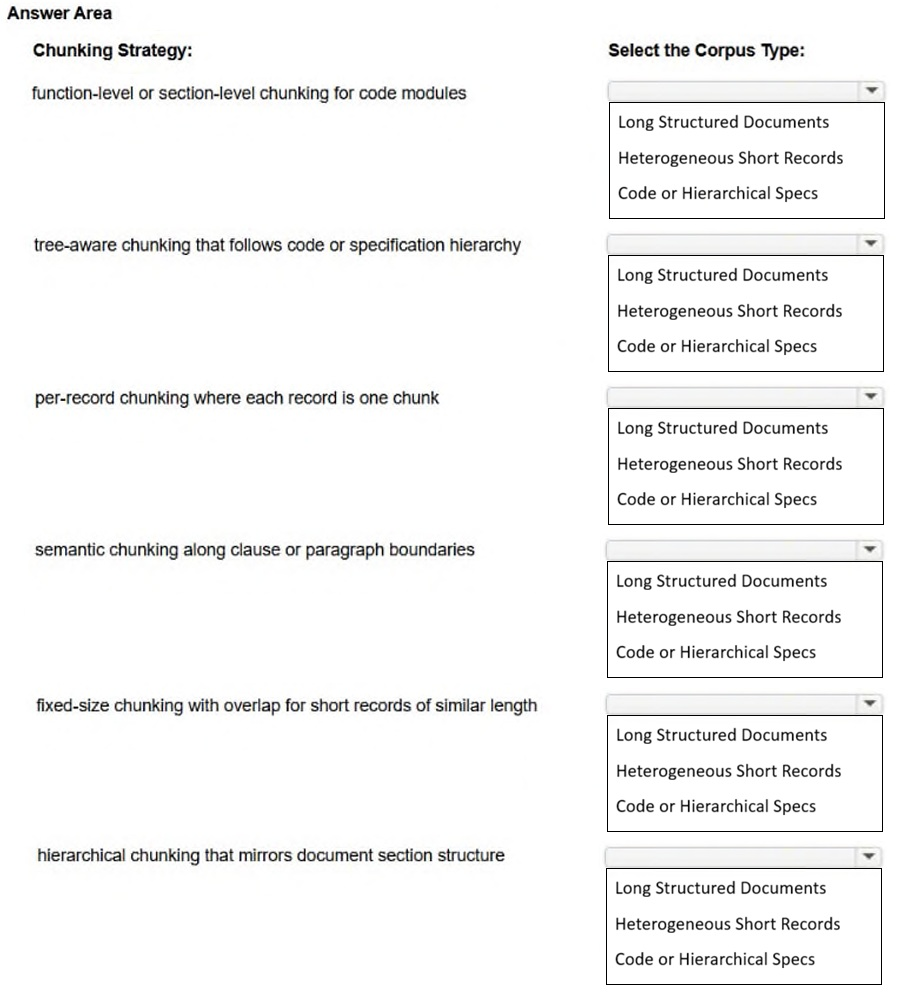
Item 1
Item 2
Item 3
Item 4
Item 5
Item 6
Show answer & explanation
Correct answer: Item 1: C · Item 2: C · Item 3: B · Item 4: A · Item 5: B · Item 6: A
ExplanationCode/spec corpora use function-level or hierarchical/tree chunking; short heterogeneous records use per-record or fixed-size overlap chunking; long structured documents use semantic or hierarchical section-aware chunking.
QUESTION 14
You are designing the prompt for a ticket-triage classifier with thirty well-defined categories and clear category descriptions in the prompt.
Which technique is most appropriate as the starting point?
Show answer & explanation
Correct answer: A
ExplanationWith a closed label set and explicit category descriptions, zero-shot prompting is the appropriate first technique; add few-shot or evaluation only if metrics show format or boundary errors. See https://docs.anthropic.com/en/docs/build-with-claude/prompt-engineering/use-xml-tags and https://docs.anthropic.com/en/docs/test-and-evaluate/develop-tests
QUESTION 15
HOTSPOT -
You are evaluating retrieval-strategy claims used by a peer team.
For each claim, select yes if the statement is generally accurate. Otherwise, select no.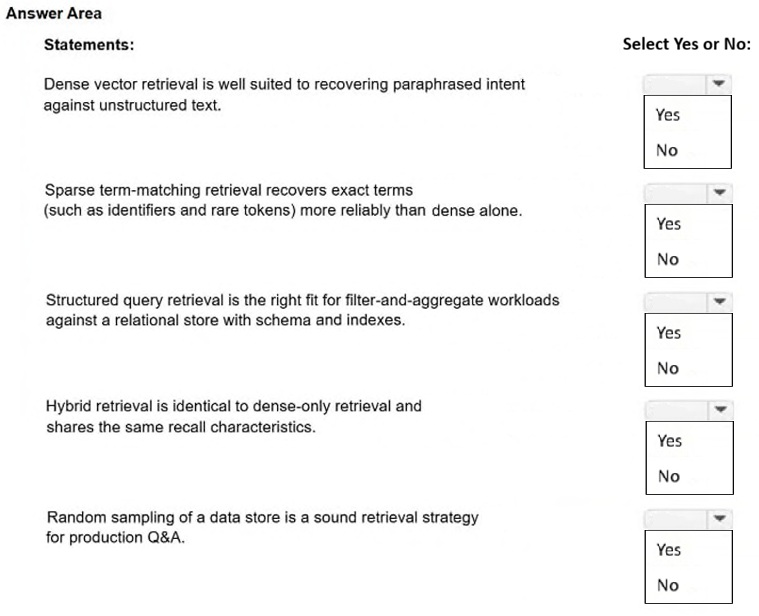
Item 1
Item 2
Item 3
Item 4
Item 5
Show answer & explanation
Correct answer: Item 1: A · Item 2: A · Item 3: A · Item 4: B · Item 5: B
ExplanationDense retrieval handles semantic paraphrase; sparse/BM25 helps exact tokens; SQL/structured engines handle filter/aggregate workloads. Hybrid combines strengths and is not equivalent to dense-only; random sampling is not a production retrieval strategy.
QUESTION 16
You are designing a content moderation classifier that processes high volumes of user-generated comments under a tight per-message latency budget using well-defined classification labels.
Which model selection best aligns with the workload?
Show answer & explanation
Correct answer: B
ExplanationHigh-volume, latency-sensitive closed-set classification aligns with the fastest Claude tier (Haiku) while reserving heavier models for complex reasoning workloads. Validate accuracy with a representative eval set before production. See https://docs.anthropic.com/en/docs/about-claude/models/overview
QUESTION 17
HOTSPOT -
You are evaluating prompting claims in a peer’s design document.
For each claim, select yes if the claim reflects sound practice. Otherwise, select no.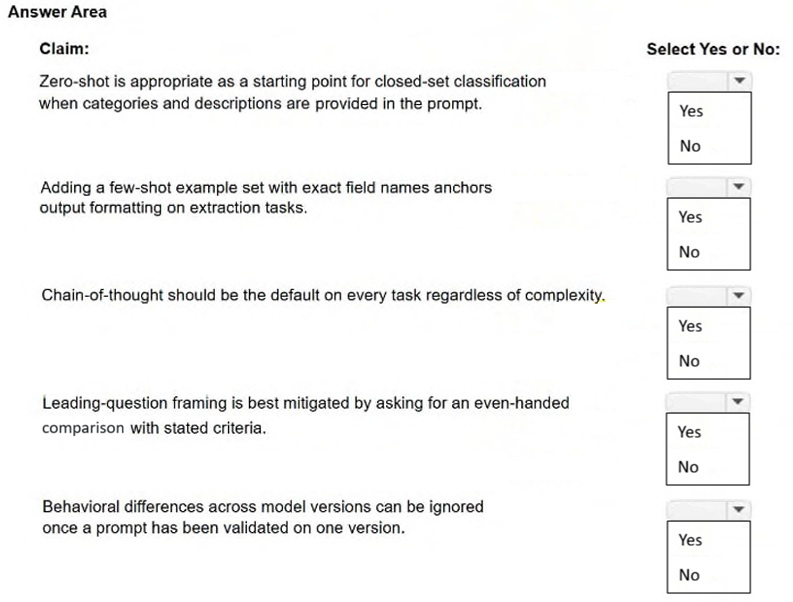
Item 1
Item 2
Item 3
Item 4
Item 5
Show answer & explanation
Correct answer: Item 1: A · Item 2: A · Item 3: B · Item 4: A · Item 5: B
ExplanationHeavier models trade cost/latency for capability; validate on representative workloads. Avoid 'always largest model' and release-date-driven selection. Tiered routing optimizes cost/latency while preserving quality where needed.
QUESTION 18
HOTSPOT -
You are evaluating model-selection claims used by a peer team.
For each statement, select yes if the statement is generally true. Otherwise, select no.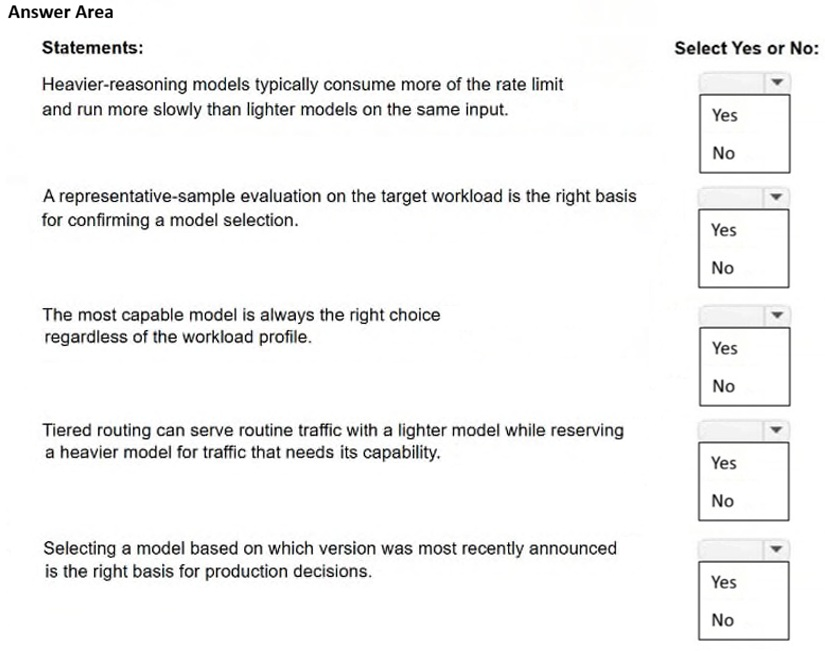
Item 1
Item 2
Item 3
Item 4
Item 5
Show answer & explanation
Correct answer: Item 1: A · Item 2: A · Item 3: B · Item 4: A · Item 5: B
ExplanationLarger models trade throughput and latency for capability; production selection should be workload-driven with representative evaluation, tiered routing, and regression checks—not release-date heuristics or always using the largest model. See https://docs.anthropic.com/en/docs/about-claude/models/overview and https://docs.anthropic.com/en/docs/test-and-evaluate/eval-tool
QUESTION 19
You are selecting a model for a new production workload and must complete the upstream steps before testing candidate models empirically.
Which two steps must be completed BEFORE running a representative sample on a candidate model? (Choose two.)
Each correct answer presents part of the solution.
Show answer & explanation
Correct answer: A, C
ExplanationBefore empirical model trials, define what “good” means (criteria/rubric) and build a representative eval set that mirrors real inputs; only then run candidate models against that set. See https://docs.anthropic.com/en/docs/test-and-evaluate/develop-tests and https://docs.anthropic.com/en/docs/test-and-evaluate/eval-tool
QUESTION 20
You are investigating an MCP server that fails on first launch but succeeds on subsequent runs. The system permission dialogs appeared on first launch.
Which response is most appropriate?
Show answer & explanation
Correct answer: D
ExplanationFirst-run OS permission prompts (workspace trust, MCP approval, macOS TCC) are expected during initial MCP onboarding. After grants are persisted, subsequent launches should succeed; document this in operator guidance rather than treating it as a defective server. See Anthropic Claude Code MCP onboarding and permission flows.
Build a focused CCAR-P practice routine.
Choose CCAR-P in Revizo and work through original, question-by-question practice on your iPhone. Review results, revisit what needs attention and keep your next session tied to one specific certification objective.
Practise CCAR-P with RevizoCCAR-P practice questions.
Is Revizo the official Anthropic exam?
No. Revizo is an independent iPhone app for certification practice. Refer to the provider's official resources for current exam policies and registration.
How should I use these CCAR-P practice questions?
Use the exam code to select the matching certification in Revizo, then build short, focused sessions around the areas you want to review.
Are Revizo questions copied from live examinations?
No. Revizo provides original practice questions for certification study. Use the provider's official objectives, documentation and policies as the source of truth for your preparation.
What should I use alongside CCAR-P practice questions?
Use the current Anthropic objectives, documentation and registration guidance as your source of truth. Revizo is designed to support focused practice, not replace the provider's official materials.
Where can I confirm current CCAR-P requirements?
Check the official Anthropic exam page for the latest objectives, registration details and policies.