Revizo / AWS / AIP-C01

AWS CERTIFICATION STUDY GUIDE

AIP-C01 practice questions.
Prepare with a clearer plan.

Validates advanced skills in AI and machine learning using AWS services.

Download Revizo
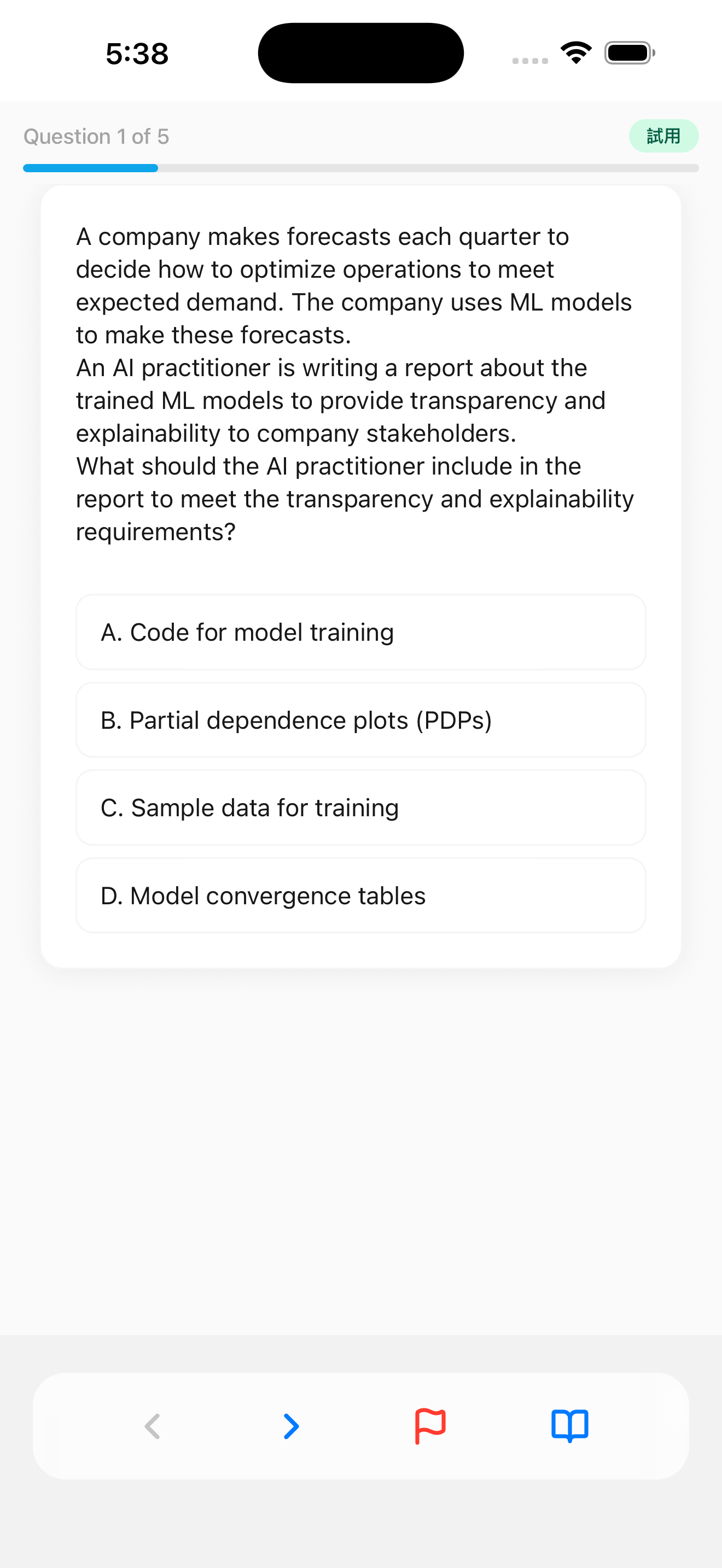
Revizo certification practice question on iPhone

What to know about AIP-C01.

Validates advanced skills in AI and machine learning using AWS services.

Format
Multiple choice and multiple response questions
Duration
170 minutes
Passing score
750/1000
Recommended experience
2+ years of AI/ML experience on AWS

Exam details are based on the available AWS catalogue information. Confirm current requirements with the exam provider before booking.

Build an AIP-C01 plan around real delivery decisions.

This professional-level guide is most useful when preparation connects foundation-model choices with integration, deployment and responsible operation—not when it is treated as a list of services to memorise.

Focus

Solution design

Architecture trade-offs, model selection, data flows and evaluation decisions.

Focus

Implementation and integration

Agentic solutions, tool use, model deployment and foundation-model API integration.

Focus

Production operations

Observability, optimisation, security, governance and lifecycle management.

AIP-C01 is about implementing generative AI in production. It is not the foundational AWS Certified AI Practitioner exam.

How to prepare for AIP-C01.

Use the provider's current objectives as your source of truth, then organise your Revizo sessions around AWS services, cloud concepts and the decisions expected in the certification. The AIP-C01 exam is listed as Multiple choice and multiple response questions; your starting point should reflect 2+ years of AI/ML experience on AWS.

01

Map the official objectives.

Read the current AWS objectives and make a short list of the areas you need to revisit before booking AIP-C01.

02

Practise one area at a time.

Select AIP-C01 in Revizo and use focused question sessions to test one topic or decision type at a time, rather than relying on a single long cram session.

03

Review, then repeat.

Use your results to return to incorrect answers, revisit the official material behind them and repeat short AIP-C01 practice sessions until the gaps are clearer.

FREE PRACTICE PREVIEW

Read the first 20
AIP-C01 questions.

Review each question, its correct answer and any available source explanation before continuing your certification study in Revizo.

FIRST 20 QUESTIONS

Answers & available explanations

QUESTION 1

A retail company has a generative AI (GenAI) product recommendation application that uses Amazon Bedrock. The application suggests products to customers based on browsing history and demographics. The company needs to implement fairness evaluation across multiple demographic groups to detect and measure bias in recommendations between two prompt approaches. The company wants to collect and monitor fairness metrics in real time. The company must receive an alert if the fairness metrics show a discrepancy of more than 15% between demographic groups. The company must receive weekly reports that compare the performance of the two prompt approaches.
Which solution will meet these requirements with the LEAST custom development effort?

  1. AA. Configure an Amazon CloudWatch dashboard to display default metrics from Amazon Bedrock API calls. Create custom metrics based on model outputs. Set up Amazon EventBridge rules to invoke AWS lambda functions that perform post-processing analysis on model responses and publish custom fairness metrics.
  2. BB. Create the two prompt variants in Amazon Bedrock Prompt Management. Use Amazon Bedrock Flows to deploy the prompt variants with defined traffic allocation. Configure Amazon Bedrock guardrails that have content filters to monitor demographic fairness. Set up Amazon CloudWatch alarms on the GuardrailContentSource dimension that use InvocationsIntervened metrics to detect recommendation discrepancy threshold violations.
  3. CC. Set up Amazon SageMaker Clarify to analyze model outputs. Publish fairness metrics to Amazon CloudWatch. Create CloudWatch composite alarms that combine SageMaker Clarify bias metrics with Amazon Bedrock latency metrics to provide a comprehensive fairness evaluation dashboard.
  4. DD. Create an Amazon Bedrock model evaluation job to compare fairness between the two prompt variants. Enable model invocation logging in Amazon CloudWatch. Set up CloudWatch alarms for InvocationsIntervened metrics with a dimension for each demographic group.
Show answer & explanation

Correct answer: C

Explanation

QUESTION 2

A finance company is developing an AI assistant to help clients plan investments and manage their portfolios. The company identifies several high-risk conversation patterns such as requests for specific stock recommendations or guaranteed returns. High-risk conversation patterns could lead to regulatory violations if the company cannot implement appropriate controls.
The company must ensure that the AI assistant does not provide inappropriate financial advice, generate content about competitors, or make claims that are not factually grounded in the company's approved financial guidance. The company wants to use Amazon Bedrock Guardrails to implement a solution.
Which combination of steps will meet these requirements? (Choose three.)

  1. AA. Add the high-risk conversation patterns to a denied topics guardrail.
  2. BB. Configure a content filter guardrail to filter prompts that contain the high-risk conversation patterns.
  3. CC. Configure a content filter guardrail to filter prompts that contain competitor names.
  4. DD. Add the names of competitors as custom word filters. Set the input and output actions to block.
  5. EE. Set a low grounding score threshold.
  6. FF. Set a high grounding score threshold.
Show answer & explanation

Correct answer: A, D, F

Explanation

QUESTION 3

A company has deployed an AI assistant as a React application that uses AWS Amplify, an AWS AppSync GraphQL API, and Amazon Bedrock Knowledge Bases. The application uses the GraphQL API to call the Amazon Bedrock RetrieveAndGenerate API for knowledge base interactions. The company configures an AWS Lambda resolver to use the RequestResponse invocation type.
Application users report frequent timeouts and slow response times. Users report these problems more frequently for complex questions that require longer processing.
The company needs a solution to fix these performance issues and enhance the user experience.
Which solution will meet these requirements?

  1. AA. Use AWS Amplify AI Kit to implement streaming responses from the GraphQL API and to optimize client-side rendering.
  2. BB. Increase the timeout value of the Lambda resolver. Implement retry logic with exponential backoff.
  3. CC. Update the application to send an API request to an Amazon SQS queue. Update the AWS AppSync resolver to poll and process the queue.
  4. DD. Change the RetrieveAndGenerate API to the InvokeModelWithResponseStream API. Update the application to use an Amazon API Gateway WebSocket API to support the streaming response.
Show answer & explanation

Correct answer: A

Explanation

QUESTION 4

An ecommerce company operates a global product recommendation system that needs to switch between multiple foundation models (FM) in Amazon Bedrock based on regulations, cost optimization, and performance requirements. The company must apply custom controls based on proprietary business logic, including dynamic cost thresholds, AWS Region-specific compliance rules, and real-time A/B testing across multiple FMs. The system must be able to switch between FMs without deploying new code. The system must route user requests based on complex rules including user tier, transaction value, regulatory zone, and real-time cost metrics that change hourly and require immediate propagation across thousands of concurrent requests.
Which solution will meet these requirements?

  1. AA. Deploy an AWS Lambda function that uses environment variables to store routing rules and Amazon Bedrock FM IDs. Use the Lambda console to update the environment variables when business requirements change. Configure an Amazon API Gateway REST API to read request parameters to make routing decisions.
  2. BB. Deploy Amazon API Gateway REST API request transformation templates to implement routing logic based on request attributes. Store Amazon Bedrock FM endpoints as REST API stage variables. Update the variables when the system switches between models.
  3. CC. Configure an AWS Lambda function to fetch routing configurations from the AWS AppConfig Agent for each user request. Run business logic in the Lambda function to select the appropriate FM for each request. Expose the FM through a single Amazon API Gateway REST API endpoint.
  4. DD. Use AWS Lambda authorizers for an Amazon API Gateway REST API to evaluate routing rules that are stored in AWS AppConfig. Return authorization contexts based on business logic. Route requests to model-specific Lambda functions for each Amazon Bedrock FM.
Show answer & explanation

Correct answer: C

Explanation

QUESTION 5

A company is developing an internal generative AI (GenAI) assistant that uses Amazon Bedrock to summarize corporate documents for multiple business units. The GenAI assistant must generate responses in a consistent format that includes a document summary, classification of business risks, and terms that are flagged for review. The GenAI assistant must adapt the tone of responses for each user's business unit, such as legal, human resources, or finance. The GenAI assistant must block hate speech, inappropriate topics, and sensitive information such as personal health information.
The company needs a solution to centrally manage prompt variants across business units and teams. The company wants to minimize ongoing orchestration efforts and maintenance for post-processing logic. The company also wants to have the ability to adjust content moderation criteria for the GenAI assistant over time.
Which solution will meet these requirements with the LEAST maintenance overhead?

  1. AA. Use Amazon Bedrock Prompt Management to configure reusable templates and business unit-specific prompt variants. Apply Amazon Bedrock guardrails that have category filters and sensitive term lists to block prohibited content.
  2. BB. Use Amazon Bedrock Prompt Management to define base templates. Enforce business unit-specific tone by using system prompt variables. Configure Amazon Bedrock guardrails to apply audience-based threshold tuning. Manage the guardrails by using an internal administration API.
  3. CC. Use Amazon Bedrock with business unit-based instruction injection in API calls. Store response formatting rules in Amazon DynamoDB. Use AWS Step functions to validate responses. Use Amazon Comprehend to apply content filters after the GenAI assistant generates responses.
  4. DD. Use Amazon Bedrock with custom prompt templates that are stored in Amazon DynamoDB. Create one AWS Lambda function to select business unit-specific prompts. Create a second Lambda function to call Amazon Comprehend to filter prohibited content from responses.
Show answer & explanation

Correct answer: A

Explanation

QUESTION 6

A financial services company is building a customer support application that retrieves relevant financial regulation documents from a database based on semantic similarities to user queries. The application must integrate with Amazon Bedrock to generate responses. The application must be able to search documents that are in English, Spanish, and Portuguese. The application must filter documents by metadata such as publication date, regulatory agency, and document type.
The database stores approximately 10 million document embeddings. To minimize operational overhead, the company wants a solution that minimizes management and maintenance effort. The application must provide low-latency responses for real-time customer interactions.
Which solution will meet these requirements?

  1. AA. Use Amazon OpenSearch Serverless to provide vector search capabilities and metadata filtering. Connect to Amazon Bedrock Knowledge Bases to enable Retrieval Augmented Generation (RAG) capabilities that use an Anthropic Claude foundation model (FM).
  2. BB. Deploy an Amazon Aurora PostgreSQL database with the pgvector extension. Define tables to store embeddings and metadata. Use SQL queries to perform similarity searches. Send retrieved documents to Amazon Bedrock to generate responses.
  3. CC. Use Amazon S3 Vectors to configure a vector index and non-filterable metadata fields. Integrate S3 Vectors with Amazon Bedrock to enable Retrieval Augmented Generation (RAG) capabilities.
  4. DD. Set up an Amazon Neptune Analytics graph database. Configure a vector index that has appropriate dimensionality to store document embeddings. Use Amazon Bedrock to perform graph-based retrieval and to generate responses.
Show answer & explanation

Correct answer: A

Explanation

QUESTION 7

A medical company is building a generative AI (GenAI) application that uses RAG to provide evidence-based medical information. The application uses Amazon OpenSearch Service to retrieve vector embeddings. Users report that searches frequently miss results that contain exact medical terms and acronyms and return too many semantically similar but irrelevant documents. The company needs to improve retrieval quality and maintain low end user latency, even as the document collection grows to millions of documents.
Which solution will meet these requirements with the LEAST operational overhead?

  1. AA. Configure hybrid search by combining vector similarity with keyword matching to improve semantic understanding and exact term and acronym matching.
  2. BB. Increase the dimensions of the vector embeddings from 384 to 1536. Use a post-processing AWS Lambda function to filter out irrelevant results after retrieval.
  3. CC. Replace OpenSearch Service with Amazon Kendra. Use query expansion to handle medical acronyms and terminology variants during pre-processing.
  4. DD. Implement a two-stage retrieval architecture in which initial vector search results are re-ranked by an ML model that is hosted on Amazon SageMaker AI.
Show answer & explanation

Correct answer: A

Explanation

QUESTION 8

A company runs a generative AI (GenAI)-powered summarization application in an application AWS account that uses Amazon Bedrock. The application architecture includes an Amazon API Gateway REST API that forwards requests to AWS Lambda functions that are attached to private VPC subnets. The application summarizes sensitive customer records that the company stores in a governed data lake in a centralized data storage account. The company has enabled Amazon S3, Amazon Athena, and AWS Glue in the data storage account.
The company must ensure that calls that the application makes to Amazon Bedrock use only private connectivity between the company's application VPC and Amazon Bedrock. The company's data lake must provide fine-grained column-level access across the company's AWS accounts.
Which solution will meet these requirements?

  1. AA. In the application account, create interface VPC endpoints for Amazon Bedrock runtimes. Run Lambda functions in private subnets. Use IAM conditions on inference and data-plane policies to allow calls only to approved endpoints and roles. In the data storage account, use AWS Lake Formation LF-tag-based access control to create table and column-level cross-account grants.
  2. BB. Run Lambda functions in private subnets. Configure a NAT gateway to provide access to Amazon Bedrock and the data lake. Use S3 bucket policies and ACLs to manage permissions. Export AWS CloudTrail logs to Amazon S3 to perform weekly reviews.
  3. CC. Create a gateway endpoint only for Amazon S3 in the application account. Invoke Amazon Bedrock through public endpoints. Use database-level grants in AWS Lake Formation to manage data access. Stream AWS CloudTrail logs to Amazon CloudWatch Logs. Do not set up metric filters or alarms.
  4. DD. Use VPC endpoints to provide access to Amazon Bedrock and Amazon S3 in the application account. Use only IAM path-based policies to manage data lake access. Send AWS CloudTrail logs to Amazon CloudWatch Logs. Periodically create dashboards and allow public fallback for cross-Region reads to reduce setup time.
Show answer & explanation

Correct answer: A

Explanation

QUESTION 9

A media company must use Amazon Bedrock to implement a robust governance process for AI-generated content. The company needs to manage hundreds of prompt templates. Multiple teams use the templates across multiple AWS Regions to generate content. The solution must provide version control with approval workflows that include notifications for pending reviews. The solution must also provide detailed audit trails that document prompt activities and consistent prompt parameterization to enforce quality standards.
Which solution will meet these requirements?

  1. AA. Configure Amazon Bedrock Studio prompt templates. Use Amazon CloudWatch to create dashboards that display prompt usage metrics. Store the approval status of content in Amazon DynamoDB. Use AWS Lambda functions to enforce approvals.
  2. BB. Use Amazon Bedrock Prompt Management to implement version control. Configure AWS CloudTrail for audit logging. Use IAM policies to control approval permissions. Create parameterized prompt templates by specifying variables.
  3. CC. Use AWS Step Functions to create an approval workflow. Store prompts as documents in Amazon S3. Use tags to implement version control. Use Amazon EventBridge to send notifications.
  4. DD. Deploy Amazon SageMaker Canvas with prompt templates that are stored in Amazon S3. Use AWS CloudFormation to implement version control. Use AWS Config to enforce approval policies.
Show answer & explanation

Correct answer: B

Explanation

QUESTION 10

A company is developing a customer support application that uses Amazon Bedrock foundation models (FMs) to provide real-time AI assistance to the company's employees. The application must display AI-generated responses character by character as the responses are generated. The application needs to support thousands of concurrent users with minimal latency. The responses typically take 15 to 45 seconds to finish.
Which solution will meet these requirements?

  1. AA. Configure an Amazon API Gateway WebSocket API with an AWS Lambda integration. Configure the WebSocket API to invoke the Amazon Bedrock InvokeModelWithResponseStream API and stream partial responses through WebSocket connections.
  2. BB. Configure an Amazon API Gateway REST API with an AWS Lambda integration. Configure the REST API to invoke the Amazon Bedrock standard InvokeModel API and implement frontend client-side polling every 100 ms for complete response chunks.
  3. CC. Implement direct frontend client connections to Amazon Bedrock by using IAM user credentials and the InvokeModelWithResponseStream API without any intermediate gateway or proxy layer.
  4. DD. Configure an Amazon API Gateway HTTP API with an AWS Lambda integration. Configure the HTTP API to cache complete responses in an Amazon DynamoDB table and serve the responses through multiple paginated GET requests to frontend clients.
Show answer & explanation

Correct answer: A

Explanation

QUESTION 11

A company is using Amazon Bedrock to design an application to help researchers apply for grants. The application is based on an Amazon Nova Pro foundation model (FM). The application contains four required inputs and must provide responses in a consistent text format. The company wants to receive a notification in Amazon Bedrock if a response contains bullying language. However, the company does not want to block all flagged responses.
The company creates an Amazon Bedrock flow that takes an input prompt and sends it to the Amazon Nova Pro FM. The Amazon Nova Pro FM provides a response.
Which additional steps must the company take to meet these requirements? (Choose two.)

  1. AA. Use Amazon Bedrock Prompt Management to specify the required inputs as variables. Select an Amazon Nova Pro FM. Specify the output format for the response. Add the prompt to the prompts node of the flow.
  2. BB. Create an Amazon Bedrock guardrail that applies the hate content filter. Set the filter response to block. Add the guardrail to the prompts node of the flow.
  3. CC. Create an Amazon Bedrock prompt router. Specify an Amazon Nova Pro FM. Add the required inputs as variables to the input node of the flow. Add the prompt router to the prompts node. Add the output format to the output node.
  4. DD. Create an Amazon Bedrock guardrail that applies the insults content filter. Set the filter response to detect. Add the guardrail to the prompts node of the flow.
  5. EE. Create an Amazon Bedrock application inference profile that specifies an Amazon Nova Pro FM. Specify the output format for the response in the description. Include a tag for each of the input variables. Add the profile to the prompts node of the flow.
Show answer & explanation

Correct answer: A, D

Explanation

QUESTION 12

A healthcare company is using Amazon Bedrock to build a Retrieval Augmented Generation (RAG) application that helps practitioners make clinical decisions. The application must achieve high accuracy for patient information retrievals, identify hallucinations in generated content, and reduce human review costs.
Which solution will meet these requirements?

  1. AA. Use Amazon Comprehend to analyze and classify RAG responses and to extract medical entities and relationships. Use AWS Step Functions to orchestrate automated evaluations. Configure Amazon CloudWatch metrics to track entity recognition confidence scores. Configure CloudWatch to send an alert when accuracy falls below specified thresholds.
  2. BB. Implement automated large language model (LLM)-based evaluations that use a specialized model that is fine-tuned for medical content to assess all responses. Deploy AWS Lambda functions to parallelize evaluations. Publish results to Amazon CloudWatch metrics that track relevance and factual accuracy.
  3. CC. Configure Amazon CloudWatch Synthetics to generate test queries that have known answers on a regular schedule, and track model success rates. Set up dashboards that compare synthetic test results against expected outcomes.
  4. DD. Deploy a hybrid evaluation system that uses an automated LLM-as-a-judge evaluation to initially screen responses and targeted human reviews for edge cases. Use Amazon SageMaker Feature Store to maintain evaluation datasets. Use a built-in Amazon Bedrock evaluation to track retrieval precision and hallucination rates.
Show answer & explanation

Correct answer: D

Explanation

QUESTION 13

Company configures a landing zone in AWS Control Tower. The company handles sensitive data that must remain within the European Union. The company must use only the eu-central-1 Region. The company uses SCPs to enforce data residency policies. GenAI developers at the company are assigned IAM roles that have full permissions for Amazon Bedrock.
The company must ensure that GenAI developers can use the Amazon Nova Pro model through Amazon Bedrock only by using cross-Region inference (CRI) and only in eu-central-1. The company enables model access for the GenAI developer IAM roles in Amazon Bedrock. However, when a GenAI developer attempts to invoke the model through the Amazon Bedrock Chat/Text playground, the GenAI developer receives the following error.
User: arn:aws:sts::123456789012:assumed-role/AssumedDevRole/DevUserName
Action: bedrock:InvokeModelWithResponseStream
On resource(s): arn:aws:bedrock:eu-west-3::foundation-model/amazon.nova-pro-v1:0
Context: a service control policy explicitly denies the action
The company needs a solution to resolve the error. The solution must retain the company's existing governance controls and must provide precise access control. The solution must comply with the company's existing data residency policies.
Which combination of solutions will meet these requirements? (Choose two.)

  1. AA. Add an AdministratorAccess policy to the GenAI developer IAM role.
  2. BB. Extend the existing SCPs to enable CRI for the eu.amazon.nova-pro-v1:0 inference profile.
  3. CC. Enable Amazon Bedrock model access for Amazon Nova Pro in the eu-west-3 Region.
  4. DD. Validate that the GenAI developer IAM roles have permissions to invoke Amazon Nova Pro through the eu.amazon.nova-pro.v1:0 inference profile on all European Union AWS Regions that can serve the model.
  5. EE. Extend the existing SCP to enable CRI for the eu.* inference profile.
Show answer & explanation

Correct answer: B, D

Explanation

QUESTION 14

A financial services company is developing a customer service AI assistant by using Amazon Bedrock. The AI assistant must not discuss investment advice with users. The AI assistant must block harmful content, mask personally identifiable information (PII), and maintain audit trails for compliance reporting. The AI assistant must apply content filtering to both user inputs and model responses based on content sensitivity.
The company requires an Amazon Bedrock guardrail configuration that will effectively enforce policies with minimal false positives. The solution must provide multiple handling strategies for multiple types of sensitive content.
Which solution will meet these requirements?

  1. AA. Configure a single guardrail and set content filters to high for all categories. Set up denied topics for investment advice and include sample phrases to block. Set up sensitive information filters that apply the block action for all PII entities. Apply the guardrail to all model inference calls.
  2. BB. Configure multiple guardrails by using tiered policies. Create one guardrail and set content filters to high. Configure the guardrail to block PII for public interactions. Configure a second guardrail and set content filters to medium. Configure the second guardrail to mask PII for internal use. Configure multiple topic-specific guardrails to block investment advice and set up contextual grounding checks.
  3. CC. Configure a guardrail and set content filters to medium for harmful content. Set up denied topics for investment advice and include clear definitions and sample phrases to block. Configure sensitive information filters to mask PII in responses and to block financial information in inputs. Enable both input and output evaluations that use custom blocked messages for audits.
  4. DD. Create a separate guardrail for each use case. Create one guardrail that applies a harmful content filter. Create a guardrail to apply topic filters for investment advice. Create a guardrail to apply sensitive information filters to block PII. Use AWS Step Functions to chain the guardrails together sequentially. Use conditional logic based on content classification.
Show answer & explanation

Correct answer: C

Explanation

QUESTION 15

An ecommerce company is developing a generative AI (GenAI) solution that uses Amazon Bedrock with Anthropic Claude to recommend products to customers. Customers report that some of the recommended products are not available for sale on the website or are not relevant to the customer. Customers also report that the solutions takes a long time to generate some recommendations.
The company investigates the issues and finds that most interactions between customers and the product recommendation solution are unique. The company confirms that the solutions recommends products that are not in the company's product catalog. The company must resolve these issues.
Which solution will meet this requirement?

  1. AA. Increase grounding within Amazon Bedrock Guardrails. Enable Automated Reasoning checks. Set up provisioned throughput.
  2. BB. Use prompt engineering to restrict the model responses to relevant products. Use streaming techniques such as the InvokeModelWithResponseStream action to reduce perceived latency for the customers.
  3. CC. Create an Amazon Bedrock knowledge base. Implement Retrieval Augmented Generation (RAG). Set the PerformanceConfigLatency parameter to optimized.
  4. DD. Store product catalog data in Amazon OpenSearch Service. Validate the model's product recommendations against the product catalog. Use Amazon DynamoDB to implement response caching.
Show answer & explanation

Correct answer: C

Explanation

QUESTION 16

A company is using AWS Lambda and REST APIs to build a reasoning agent to automate support workflows. The system must preserve memory across interactions, share the relevant agent state, and support event-driven invocation and synchronous invocation. The system must also enforce access control and session-based permissions.
Which combination of steps provides the MOST scalable solution? (Choose two.)

  1. AA. Use Amazon Bedrock AgentCore to manage memory and session-aware reasoning. Deploy the agent with built-in identity support, event handling, and observability.
  2. BB. Register the Lambda functions and the REST APIs as actions by using Amazon API Gateway and Amazon EventBridge. Enable Amazon Bedrock AgentCore to invoke the Lambda functions and the REST APIs without custom orchestration code.
  3. CC. Use Amazon Bedrock Agents for reasoning and conversation management. Use AWS Step Functions and Amazon SQS queues for orchestration. Store the agent state in Amazon DynamoDB to maintain memory between steps.
  4. DD. Deploy the reasoning logic as a container on Amazon ECS behind Amazon API Gateway. Use Amazon Aurora to store memory data and identity data.
  5. EE. Build a custom RAG pipeline by using Amazon Kendra and Amazon Bedrock. Use AWS Lambda to orchestrate tool invocations. Store the agent state in Amazon S3.
Show answer & explanation

Correct answer: A, B

Explanation

QUESTION 17

A financial services company is developing a Retrieval Augmented Generation (RAG) application to help investment analysts query complex financial relationships across multiple investment vehicles, market sectors, and regulatory environments. The dataset contains highly interconnected entities that have multi-hop relationships. The analysts must be able to examine the relationships holistically to provide accurate investment guidance. The application must deliver comprehensive answers that capture indirect relationships between financial entities. The application must produce responses in less than 3 seconds.
Which solution will meet these requirements with the LEAST operational overhead?

  1. AA. Use Amazon Bedrock Knowledge Bases with Graph RAG and Amazon Neptune Analytics to store the financial data. Analyze the multi-hop relationships between entities and automatically identify related information across documents.
  2. BB. Use Amazon Bedrock Knowledge Bases and an Amazon OpenSearch Service vector store to implement custom relationship identification logic that uses AWS Lambda functions to query multiple vector embeddings in sequence.
  3. CC. Use an Amazon OpenSearch Serverless vector database with k-nearest neighbor (k-NN) searches. Implement manual relationship mapping in an application layer that runs in an Amazon EC2 Auto Scaling group.
  4. DD. Use Amazon DynamoDB to store financial data in a custom indexing system. Use an AWS Lambda function to query relevant records based on input questions. Use Amazon SageMaker AI to generate responses.
Show answer & explanation

Correct answer: A

Explanation

QUESTION 18

A healthcare company uses Amazon Bedrock to deploy an application that generates summaries of clinical documents. The application experiences inconsistent response quality with occasional factual hallucinations. Monthly costs exceed the company's projections by 40%. A GenAI developer must implement a near real-time monitoring solution to detect hallucinations, identify abnormal token consumption, and provide early warnings of cost anomalies. The solution must require minimal custom development work and maintenance overhead.
Which solution will meet these requirements?

  1. AA. Configure Amazon CloudWatch alarms to monitor InputTokenCount and OutputTokenCount metrics to detect anomalies. Store model invocation logs in an Amazon S3 bucket. Use AWS Glue and Amazon Athena to identify potential hallucinations.
  2. BB. Run Amazon Bedrock evaluation jobs that use LLM-based judgments to detect hallucinations. Configure Amazon CloudWatch to track token usage. Create an AWS Lambda function to process CloudWatch metrics. Configure the Lambda function to send usage pattern notifications.
  3. CC. Configure Amazon Bedrock to store model invocation logs in an Amazon S3 bucket. Enable text output logging. Configure Amazon Bedrock guardrails to run contextual grounding checks to detect hallucinations. Create Amazon CloudWatch anomaly detection alarms for token usage metrics.
  4. DD. Use AWS CloudTrail to log all Amazon Bedrock API calls. Create a custom dashboard in Amazon QuickSight to visualize token usage patterns. Use Amazon SageMaker Model Monitor to detect quality drift in generated summaries.
Show answer & explanation

Correct answer: C

Explanation

QUESTION 19

A company is building a generative AI (GenAI) application that produces content based on a variety of internal and external data sources. The company wants to ensure that the generated output is fully traceable. The application must support data source registration and enable metadata tagging to attribute content to its original source. The application must also maintain audit logs of data access and usage throughout the pipeline.
Which solution will meet these requirements?

  1. AA. Use AWS Lake Formation to catalog data sources and control access. Apply metadata tags directly in Amazon S3. Use AWS CloudTrail to monitor API activity.
  2. BB. Use AWS Glue Data Catalog to register and tag data sources. Use Amazon CloudWatch Logs to monitor access patterns and application behavior.
  3. CC. Store data in Amazon S3 and use object tagging for attribution. Use AWS Glue Data Catalog to manage schema information. Use AWS CloudTrail to log access to S3 buckets.
  4. DD. Use AWS Glue Data Catalog to register all data sources. Apply metadata tags to attribute data sources. Use AWS CloudTrail to log access and activity across services.
Show answer & explanation

Correct answer: D

Explanation

QUESTION 20

A financial services company needs to build a document analysis system that uses Amazon Bedrock to process quarterly reports. The system must analyze financial data, perform sentiment analysis, and validate compliance across batches of reports. Each batch contains 5 reports. Each report requires multiple foundation model (FM) calls. The solution must finish the analysis within 10 seconds for each batch. Current sequential processing takes 45 seconds for each batch.
Which solution will meet these requirements?

  1. AA. Use AWS Lambda functions with provisioned concurrency to process each analysis type sequentially. Configure the Lambda function timeouts to 10 seconds. Configure automatic retries with exponential backoff.
  2. BB. Use AWS Step Functions with a Parallel state to invoke separate AWS Lambda functions for each analysis type simultaneously. Configure Amazon Bedrock client timeouts. Use Amazon CloudWatch metrics to track execution time and model inference latency.
  3. CC. Create an Amazon SQS queue to buffer analysis requests. Deploy multiple AWS Lambda functions with reserved concurrency. Configure each Lambda function to process different aspects of each report sequentially and then combine the results.
  4. DD. Deploy an Amazon ECS cluster that runs containers that process each report sequentially. Use a load balancer to distribute batch workloads. Configure an auto-scaling policy based on CPU utilization to handle demand fluctuations.
Show answer & explanation

Correct answer: B

Explanation

Build a focused AIP-C01 practice routine.

Choose AIP-C01 in Revizo and work through original, question-by-question practice on your iPhone. Review results, revisit what needs attention and keep your next session tied to one specific certification objective.

Practise AIP-C01 with Revizo

AIP-C01 practice questions.

Is Revizo the official AWS exam?

No. Revizo is an independent iPhone app for certification practice. Refer to the provider's official resources for current exam policies and registration.

How should I use these AIP-C01 practice questions?

Use the exam code to select the matching certification in Revizo, then build short, focused sessions around the areas you want to review.

Are Revizo questions copied from live examinations?

No. Revizo provides original practice questions for certification study. Use the provider's official objectives, documentation and policies as the source of truth for your preparation.

What should I use alongside AIP-C01 practice questions?

Use the current AWS objectives, documentation and registration guidance as your source of truth. Revizo is designed to support focused practice, not replace the provider's official materials.

Where can I confirm current AIP-C01 requirements?

Check the official AWS exam page for the latest objectives, registration details and policies.