Revizo / Google / GCP-PCA

GOOGLE CERTIFICATION STUDY GUIDE

GCP-PCA practice questions.
Prepare with a clearer plan.

Demonstrates ability to design, develop, and manage robust, secure, scalable Google Cloud solutions.

Download Revizo
Revizo certification practice question on iPhone

What to know about GCP-PCA.

Demonstrates ability to design, develop, and manage robust, secure, scalable Google Cloud solutions.

Format
Multiple choice and case study questions
Duration
120 minutes
Passing score
700/1000
Recommended experience
3+ years of cloud architecture experience

Exam details are based on the available Google catalogue information. Confirm current requirements with the exam provider before booking.

How to prepare for GCP-PCA.

Use the provider's current objectives as your source of truth, then organise your Revizo sessions around Google Cloud products, platform concepts and the practical decisions named in the certification. The GCP-PCA exam is listed as Multiple choice and case study questions; your starting point should reflect 3+ years of cloud architecture experience.

01

Map the official objectives.

Read the current Google objectives and make a short list of the areas you need to revisit before booking GCP-PCA.

02

Practise one area at a time.

Select GCP-PCA in Revizo and use focused question sessions to test one topic or decision type at a time, rather than relying on a single long cram session.

03

Review, then repeat.

Use your results to return to incorrect answers, revisit the official material behind them and repeat short GCP-PCA practice sessions until the gaps are clearer.

FREE PRACTICE PREVIEW

Read the first 20
GCP-PCA questions.

Review each question, its correct answer and any available source explanation before continuing your certification study in Revizo.

FIRST 20 QUESTIONS

Answers & available explanations

QUESTION 1

Your company has decided to make a major revision of their API in order to create better experiences for their developers. They need to keep the old version of the API available and deployable, while allowing new customers and testers to try out the new API. They want to keep the same SSL and DNS records in place to serve both APIs.
What should they do?

  1. AA. Configure a new load balancer for the new version of the API
  2. BB. Reconfigure old clients to use a new endpoint for the new API
  3. CC. Have the old API forward traffic to the new API based on the path
  4. DD. Use separate backend pools for each API path behind the load balancer
Show answer & explanation

Correct answer: D

Explanation

QUESTION 2

Your company plans to migrate a multi-petabyte data set to the cloud. The data set must be available 24hrs a day. Your business analysts have experience only with using a SQL interface.
How should you store the data to optimize it for ease of analysis?

  1. AA. Load data into Google BigQuery
  2. BB. Insert data into Google Cloud SQL
  3. CC. Put flat files into Google Cloud Storage
  4. DD. Stream data into Google Cloud Datastore
Show answer & explanation

Correct answer: A

ExplanationBigQuery is Google's serverless, highly scalable, low cost enterprise data warehouse designed to make all your data analysts productive. Because there is no infrastructure to manage, you can focus on analyzing data to find meaningful insights using familiar SQL and you don't need a database administrator.
BigQuery enables you to analyze all your data by creating a logical data warehouse over managed, columnar storage as well as data from object storage, and spreadsheets.
Reference:
https://cloud.google.com/bigquery/

QUESTION 3

The operations manager asks you for a list of recommended practices that she should consider when migrating a J2EE application to the cloud.
Which three practices should you recommend? (Choose three.)

  1. AA. Port the application code to run on Google App Engine
  2. BB. Integrate Cloud Dataflow into the application to capture real-time metrics
  3. CC. Instrument the application with a monitoring tool like Stackdriver Debugger
  4. DD. Select an automation framework to reliably provision the cloud infrastructure
  5. EE. Deploy a continuous integration tool with automated testing in a staging environment
  6. FF. Migrate from MySQL to a managed NoSQL database like Google Cloud Datastore or Bigtable
Show answer & explanation

Correct answer: C, D, E

ExplanationCDE looks like correct . Porting a J2EE application to App Engine will not work as its is - there are three arpproach for migration - There are three major types of migrations: Lift and shift Improve and move Rip and replace So Option A can be discarded . So the answer is CDE .

QUESTION 4

A news feed web service has the following code running on Google App Engine. During peak load, users report that they can see news articles they already viewed.
What is the most likely cause of this problem?
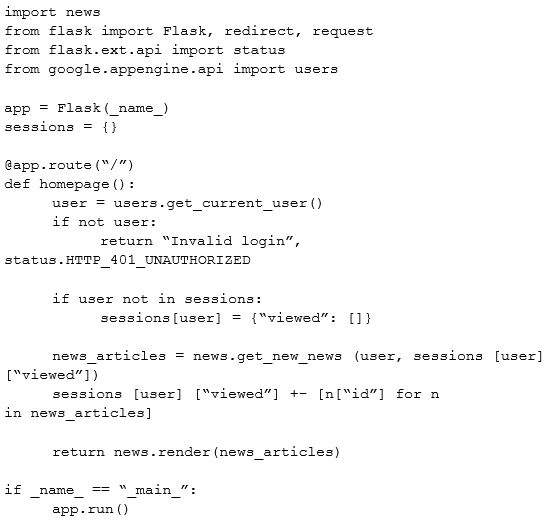
  1. AA. The session variable is local to just a single instance
  2. BB. The session variable is being overwritten in Cloud Datastore
  3. CC. The URL of the API needs to be modified to prevent caching
  4. DD. The HTTP Expires header needs to be set to -1 stop caching
Show answer & explanation

Correct answer: A

Explanation

QUESTION 5

An application development team believes their current logging tool will not meet their needs for their new cloud-based product. They want a better tool to capture errors and help them analyze their historical log data. You want to help them find a solution that meets their needs.
What should you do?

  1. AA. Direct them to download and install the Google StackDriver logging agent
  2. BB. Send them a list of online resources about logging best practices
  3. CC. Help them define their requirements and assess viable logging tools
  4. DD. Help them upgrade their current tool to take advantage of any new features
Show answer & explanation

Correct answer: A

ExplanationThis is GCP exam. They will always promote their services. Not a third party solution.

QUESTION 6

You need to reduce the number of unplanned rollbacks of erroneous production deployments in your company's web hosting platform. Improvement to the QA/
Test processes accomplished an 80% reduction.
Which additional two approaches can you take to further reduce the rollbacks? (Choose two.)

  1. AA. Introduce a green-blue deployment model
  2. BB. Replace the QA environment with canary releases
  3. CC. Fragment the monolithic platform into microservices
  4. DD. Reduce the platform's dependency on relational database systems
  5. EE. Replace the platform's relational database systems with a NoSQL database
Show answer & explanation

Correct answer: A, C

Explanation

QUESTION 7

To reduce costs, the Director of Engineering has required all developers to move their development infrastructure resources from on-premises virtual machines
(VMs) to Google Cloud Platform. These resources go through multiple start/stop events during the day and require state to persist. You have been asked to design the process of running a development environment in Google Cloud while providing cost visibility to the finance department.
Which two steps should you take? (Choose two.)

  1. AA. Use the - -no-auto-delete flag on all persistent disks and stop the VM
  2. BB. Use the - -auto-delete flag on all persistent disks and terminate the VM
  3. CC. Apply VM CPU utilization label and include it in the BigQuery billing export
  4. DD. Use Google BigQuery billing export and labels to associate cost to groups
  5. EE. Store all state into local SSD, snapshot the persistent disks, and terminate the VM
  6. FF. Store all state in Google Cloud Storage, snapshot the persistent disks, and terminate the VM
Show answer & explanation

Correct answer: A, D

Explanation

QUESTION 8

Your company wants to track whether someone is present in a meeting room reserved for a scheduled meeting. There are 1000 meeting rooms across 5 offices on 3 continents. Each room is equipped with a motion sensor that reports its status every second. The data from the motion detector includes only a sensor ID and several different discrete items of information. Analysts will use this data, together with information about account owners and office locations.
Which database type should you use?

  1. AA. Flat file
  2. BB. NoSQL
  3. CC. Relational
  4. DD. Blobstore
Show answer & explanation

Correct answer: B

ExplanationRelational databases were not designed to cope with the scale and agility challenges that face modern applications, nor were they built to take advantage of the commodity storage and processing power available today.
NoSQL fits well for:
✑ Developers are working with applications that create massive volumes of new, rapidly changing data types ג€' structured, semi-structured, unstructured and polymorphic data.
Incorrect Answers:
D: The Blobstore API allows your application to serve data objects, called blobs, that are much larger than the size allowed for objects in the Datastore service.
Blobs are useful for serving large files, such as video or image files, and for allowing users to upload large data files.
Reference:
https://www.mongodb.com/nosql-explained

QUESTION 9

You set up an autoscaling instance group to serve web traffic for an upcoming launch. After configuring the instance group as a backend service to an HTTP(S) load balancer, you notice that virtual machine (VM) instances are being terminated and re-launched every minute. The instances do not have a public IP address.
You have verified the appropriate web response is coming from each instance using the curl command. You want to ensure the backend is configured correctly.
What should you do?

  1. AA. Ensure that a firewall rules exists to allow source traffic on HTTP/HTTPS to reach the load balancer.
  2. BB. Assign a public IP to each instance and configure a firewall rule to allow the load balancer to reach the instance public IP.
  3. CC. Ensure that a firewall rule exists to allow load balancer health checks to reach the instances in the instance group.
  4. DD. Create a tag on each instance with the name of the load balancer. Configure a firewall rule with the name of the load balancer as the source and the instance tag as the destination.
Show answer & explanation

Correct answer: C

ExplanationThe best practice when configuration a health check is to check health and serve traffic on the same port. However, it is possible to perform health checks on one port, but serve traffic on another. If you do use two different ports, ensure that firewall rules and services running on instances are configured appropriately. If you run health checks and serve traffic on the same port, but decide to switch ports at some point, be sure to update both the backend service and the health check.
Backend services that do not have a valid global forwarding rule referencing it will not be health checked and will have no health status.
Reference:
https://cloud.google.com/compute/docs/load-balancing/http/backend-service

QUESTION 10

You write a Python script to connect to Google BigQuery from a Google Compute Engine virtual machine. The script is printing errors that it cannot connect to
BigQuery.
What should you do to fix the script?

  1. AA. Install the latest BigQuery API client library for Python
  2. BB. Run your script on a new virtual machine with the BigQuery access scope enabled
  3. CC. Create a new service account with BigQuery access and execute your script with that user
  4. DD. Install the bq component for gcloud with the command gcloud components install bq.
Show answer & explanation

Correct answer: C

ExplanationA - If client library was not installed, the python scripts won't run - since the question states the script reports "cannot connect" - the client library must have been installed. so it's B or C. B - https://cloud.google.com/bigquery/docs/authorization an access scope is how your client application retrieve access_token with access permission in OAuth when you want to access services via API call - in this case, it is possible that the python script use an API call instead of library, if this is true, then access scope is required. client library requires no access scope (as it does not go through OAuth) C - service account is Google Cloud's best practice

QUESTION 11

Your customer is moving an existing corporate application to Google Cloud Platform from an on-premises data center. The business owners require minimal user disruption. There are strict security team requirements for storing passwords.
What authentication strategy should they use?

  1. AA. Use G Suite Password Sync to replicate passwords into Google
  2. BB. Federate authentication via SAML 2.0 to the existing Identity Provider
  3. CC. Provision users in Google using the Google Cloud Directory Sync tool
  4. DD. Ask users to set their Google password to match their corporate password
Show answer & explanation

Correct answer: B

ExplanationGCDS tool only copies the usernames, not the passwords. And more over strict security requirements for the passwords. Not allowed to copy them onto Google, I think.

QUESTION 12

Your company has successfully migrated to the cloud and wants to analyze their data stream to optimize operations. They do not have any existing code for this analysis, so they are exploring all their options. These options include a mix of batch and stream processing, as they are running some hourly jobs and live- processing some data as it comes in.
Which technology should they use for this?

  1. AA. Google Cloud Dataproc
  2. BB. Google Cloud Dataflow
  3. CC. Google Container Engine with Bigtable
  4. DD. Google Compute Engine with Google BigQuery
Show answer & explanation

Correct answer: B

ExplanationCloud Dataflow is a fully-managed service for transforming and enriching data in stream (real time) and batch (historical) modes with equal reliability and expressiveness -- no more complex workarounds or compromises needed.
Reference:
https://cloud.google.com/dataflow/

QUESTION 13

Your customer is receiving reports that their recently updated Google App Engine application is taking approximately 30 seconds to load for some of their users.
This behavior was not reported before the update.
What strategy should you take?

  1. AA. Work with your ISP to diagnose the problem
  2. BB. Open a support ticket to ask for network capture and flow data to diagnose the problem, then roll back your application
  3. CC. Roll back to an earlier known good release initially, then use Stackdriver Trace and Logging to diagnose the problem in a development/test/staging environment
  4. DD. Roll back to an earlier known good release, then push the release again at a quieter period to investigate. Then use Stackdriver Trace and Logging to diagnose the problem
Show answer & explanation

Correct answer: C

ExplanationStackdriver Logging allows you to store, search, analyze, monitor, and alert on log data and events from Google Cloud Platform and Amazon Web Services
(AWS). Our API also allows ingestion of any custom log data from any source. Stackdriver Logging is a fully managed service that performs at scale and can ingest application and system log data from thousands of VMs. Even better, you can analyze all that log data in real time.
Reference:
https://cloud.google.com/logging/

QUESTION 14

A production database virtual machine on Google Compute Engine has an ext4-formatted persistent disk for data files. The database is about to run out of storage space.
How can you remediate the problem with the least amount of downtime?

  1. AA. In the Cloud Platform Console, increase the size of the persistent disk and use the resize2fs command in Linux.
  2. BB. Shut down the virtual machine, use the Cloud Platform Console to increase the persistent disk size, then restart the virtual machine
  3. CC. In the Cloud Platform Console, increase the size of the persistent disk and verify the new space is ready to use with the fdisk command in Linux
  4. DD. In the Cloud Platform Console, create a new persistent disk attached to the virtual machine, format and mount it, and configure the database service to move the files to the new disk
  5. EE. In the Cloud Platform Console, create a snapshot of the persistent disk restore the snapshot to a new larger disk, unmount the old disk, mount the new disk and restart the database service
Show answer & explanation

Correct answer: A

ExplanationOn Linux instances, connect to your instance and manually resize your partitions and file systems to use the additional disk space that you added.
Extend the file system on the disk or the partition to use the added space. If you grew a partition on your disk, specify the partition. If your disk does not have a partition table, specify only the disk ID. sudo resize2fs /dev/[DISK_ID][PARTITION_NUMBER] where [DISK_ID] is the device name and [PARTITION_NUMBER] is the partition number for the device where you are resizing the file system.
Reference:
https://cloud.google.com/compute/docs/disks/add-persistent-disk

QUESTION 15

Your application needs to process credit card transactions. You want the smallest scope of Payment Card Industry (PCI) compliance without compromising the ability to analyze transactional data and trends relating to which payment methods are used.
How should you design your architecture?

  1. AA. Create a tokenizer service and store only tokenized data
  2. BB. Create separate projects that only process credit card data
  3. CC. Create separate subnetworks and isolate the components that process credit card data
  4. DD. Streamline the audit discovery phase by labeling all of the virtual machines (VMs) that process PCI data
  5. EE. Enable Logging export to Google BigQuery and use ACLs and views to scope the data shared with the auditor
Show answer & explanation

Correct answer: A

ExplanationReference:
https://www.sans.org/reading-room/whitepapers/compliance/ways-reduce-pci-dss-audit-scope-tokenizing-cardholder-data-33194

QUESTION 16

You have been asked to select the storage system for the click-data of your company's large portfolio of websites. This data is streamed in from a custom website analytics package at a typical rate of 6,000 clicks per minute. With bursts of up to 8,500 clicks per second. It must have been stored for future analysis by your data science and user experience teams.
Which storage infrastructure should you choose?

  1. AA. Google Cloud SQL
  2. BB. Google Cloud Bigtable
  3. CC. Google Cloud Storage
  4. DD. Google Cloud Datastore
Show answer & explanation

Correct answer: B

ExplanationGoogle Cloud Bigtable is a scalable, fully-managed NoSQL wide-column database that is suitable for both real-time access and analytics workloads.
Good for:
✑ Low-latency read/write access
✑ High-throughput analytics
✑ Native time series support
Common workloads:
✑ IoT, finance, adtech
✑ Personalization, recommendations
✑ Monitoring
✑ Geospatial datasets
✑ Graphs
Incorrect Answers:
C: Google Cloud Storage is a scalable, fully-managed, highly reliable, and cost-efficient object / blob store.
Is good for:
✑ Images, pictures, and videos
✑ Objects and blobs
✑ Unstructured data
D: Google Cloud Datastore is a scalable, fully-managed NoSQL document database for your web and mobile applications.
Is good for:
✑ Semi-structured application data
✑ Hierarchical data
✑ Durable key-value data
✑ Common workloads:
✑ User profiles
✑ Product catalogs
✑ Game state
Reference:
https://cloud.google.com/storage-options/

QUESTION 17

You are creating a solution to remove backup files older than 90 days from your backup Cloud Storage bucket. You want to optimize ongoing Cloud Storage spend.
What should you do?

  1. AA. Write a lifecycle management rule in XML and push it to the bucket with gsutil
  2. BB. Write a lifecycle management rule in JSON and push it to the bucket with gsutil
  3. CC. Schedule a cron script using gsutil ls ג€"lr gs://backups/** to find and remove items older than 90 days
  4. DD. Schedule a cron script using gsutil ls ג€"l gs://backups/** to find and remove items older than 90 days and schedule it with cron
Show answer & explanation

Correct answer: B

Explanation

QUESTION 18

Your company is forecasting a sharp increase in the number and size of Apache Spark and Hadoop jobs being run on your local datacenter. You want to utilize the cloud to help you scale this upcoming demand with the least amount of operations work and code change.
Which product should you use?

  1. AA. Google Cloud Dataflow
  2. BB. Google Cloud Dataproc
  3. CC. Google Compute Engine
  4. DD. Google Kubernetes Engine
Show answer & explanation

Correct answer: B

ExplanationGoogle Cloud Dataproc is a fast, easy-to-use, low-cost and fully managed service that lets you run the Apache Spark and Apache Hadoop ecosystem on Google
Cloud Platform. Cloud Dataproc provisions big or small clusters rapidly, supports many popular job types, and is integrated with other Google Cloud Platform services, such as Google Cloud Storage and Stackdriver Logging, thus helping you reduce TCO.
Reference:
https://cloud.google.com/dataproc/docs/resources/faq

QUESTION 19

The database administration team has asked you to help them improve the performance of their new database server running on Google Compute Engine. The database is for importing and normalizing their performance statistics and is built with MySQL running on Debian Linux. They have an n1-standard-8 virtual machine with 80 GB of SSD persistent disk.
What should they change to get better performance from this system?

  1. AA. Increase the virtual machine's memory to 64 GB
  2. BB. Create a new virtual machine running PostgreSQL
  3. CC. Dynamically resize the SSD persistent disk to 500 GB
  4. DD. Migrate their performance metrics warehouse to BigQuery
  5. EE. Modify all of their batch jobs to use bulk inserts into the database
Show answer & explanation

Correct answer: C

Explanation

QUESTION 20

You want to optimize the performance of an accurate, real-time, weather-charting application. The data comes from 50,000 sensors sending 10 readings a second, in the format of a timestamp and sensor reading.
Where should you store the data?

  1. AA. Google BigQuery
  2. BB. Google Cloud SQL
  3. CC. Google Cloud Bigtable
  4. DD. Google Cloud Storage
Show answer & explanation

Correct answer: C

ExplanationGoogle Cloud Bigtable is a scalable, fully-managed NoSQL wide-column database that is suitable for both real-time access and analytics workloads.
Good for:
✑ Low-latency read/write access
✑ High-throughput analytics
✑ Native time series support
Common workloads:
✑ IoT, finance, adtech
✑ Personalization, recommendations
✑ Monitoring
✑ Geospatial datasets
✑ Graphs
Reference:
https://cloud.google.com/storage-options/

Build a focused GCP-PCA practice routine.

Choose GCP-PCA in Revizo and work through original, question-by-question practice on your iPhone. Review results, revisit what needs attention and keep your next session tied to one specific certification objective.

Practise GCP-PCA with Revizo

GCP-PCA practice questions.

Is Revizo the official Google exam?

No. Revizo is an independent iPhone app for certification practice. Refer to the provider's official resources for current exam policies and registration.

How should I use these GCP-PCA practice questions?

Use the exam code to select the matching certification in Revizo, then build short, focused sessions around the areas you want to review.

Are Revizo questions copied from live examinations?

No. Revizo provides original practice questions for certification study. Use the provider's official objectives, documentation and policies as the source of truth for your preparation.

What should I use alongside GCP-PCA practice questions?

Use the current Google objectives, documentation and registration guidance as your source of truth. Revizo is designed to support focused practice, not replace the provider's official materials.

Where can I confirm current GCP-PCA requirements?

Check the official Google exam page for the latest objectives, registration details and policies.