Map the official objectives.
Read the current Microsoft objectives and make a short list of the areas you need to revisit before booking AZ-700.
MICROSOFT CERTIFICATION STUDY GUIDE
Demonstrates expertise in designing and implementing Azure networking solutions.
Download Revizo
Demonstrates expertise in designing and implementing Azure networking solutions.
Exam details are based on the available Microsoft catalogue information. Confirm current requirements with the exam provider before booking.
Use the provider's current objectives as your source of truth, then organise your Revizo sessions around the Microsoft technologies, product capabilities and implementation decisions named in the certification. The AZ-700 exam is listed as Multiple choice questions; your starting point should reflect 1+ years of Azure networking experience.
Read the current Microsoft objectives and make a short list of the areas you need to revisit before booking AZ-700.
Select AZ-700 in Revizo and use focused question sessions to test one topic or decision type at a time, rather than relying on a single long cram session.
Use your results to return to incorrect answers, revisit the official material behind them and repeat short AZ-700 practice sessions until the gaps are clearer.
FREE PRACTICE PREVIEW
Review each question, its correct answer and any available source explanation before continuing your certification study in Revizo.
Answers & available explanations
QUESTION 1
Your company has a single on-premises datacenter in Washington DC. The East US Azure region has a peering location in Washington DC.
The company only has Azure resources in the East US region.
You need to implement ExpressRoute to support up to 1 Gbps. You must use only ExpressRoute Unlimited data plans. The solution must minimize costs.
Which type of ExpressRoute circuits should you create?
Correct answer: A
QUESTION 2
You are planning an Azure Point-to-Site (P2S) VPN that will use OpenVPN.
Users will authenticate by an on-premises Active Directory domain.
Which additional service should you deploy to support the VPN authentication?
Correct answer: B
QUESTION 3
You plan to configure BGP for a Site-to-Site VPN connection between a datacenter and Azure.
Which two Azure resources should you configure? Each correct answer presents a part of the solution. (Choose two.)
NOTE: Each correct selection is worth one point.
Correct answer: A, D
QUESTION 4
You fail to establish a Site-to-Site VPN connection between your company's main office and an Azure virtual network.
You need to troubleshoot what prevents you from establishing the IPsec tunnel.
Which diagnostic log should you review?
Correct answer: A
QUESTION 5
You have an Azure virtual network and an on-premises datacenter.
You are planning a Site-to-Site VPN connection between the datacenter and the virtual network.
Which two resources should you include in your plan? Each correct answer presents part of the solution.
NOTE: Each correct selection is worth one point.
Correct answer: B, G
QUESTION 6
HOTSPOT -
You need to connect an on-premises network and an Azure environment. The solution must use ExpressRoute and support failing over to a Site-to-Site VPN connection if there is an ExpressRoute failure.
What should you configure? To answer, select the appropriate options in the answer area.
NOTE: Each correct selection is worth one point.
Hot Area: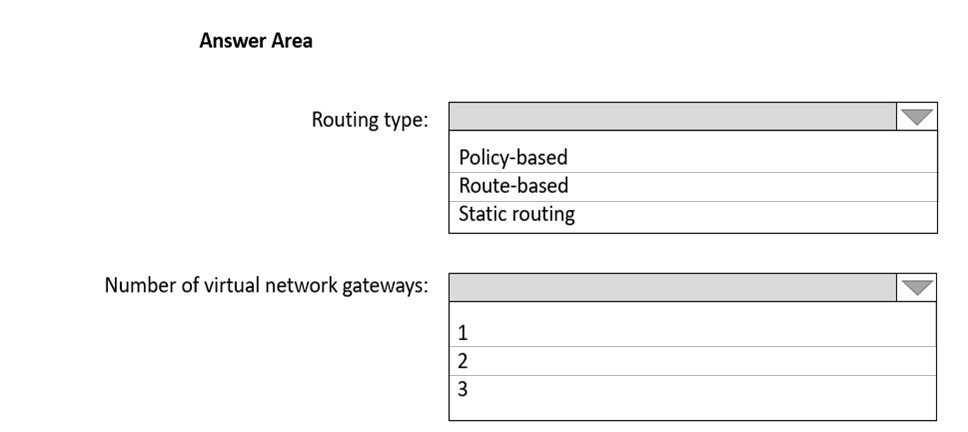
Correct answer: Item 1: B · Item 2: B
QUESTION 7
Your company has an on-premises network and three Azure subscriptions named Subscription1, Subscription2, and Subscription3.
The departments at the company use the Azure subscriptions as shown in the following table.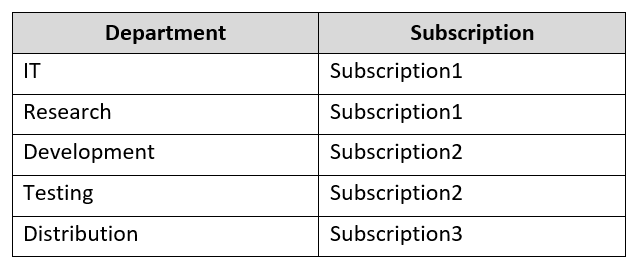
All the resources in the subscriptions are in either the West US Azure region or the West US 2 Azure region.
You plan to connect all the subscriptions to the on-premises network by using ExpressRoute.
What is the minimum number of ExpressRoute circuits required?
Correct answer: A
QUESTION 8
Your company has offices in New York and Amsterdam. The company has an Azure subscription. Both offices connect to Azure by using a Site-to-Site VPN connection.
The office in Amsterdam uses resources in the North Europe Azure region. The office in New York uses resources in the East US Azure region.
You need to implement ExpressRoute circuits to connect each office to the nearest Azure region. Once the ExpressRoute circuits are connected, the on-premises computers in the Amsterdam office must be able to connect to the on-premises servers in the New York office by using the ExpressRoute circuits.
Which ExpressRoute option should you use?
Correct answer: B
QUESTION 9
HOTSPOT -
You have an Azure subscription that contains a single virtual network and a virtual network gateway.
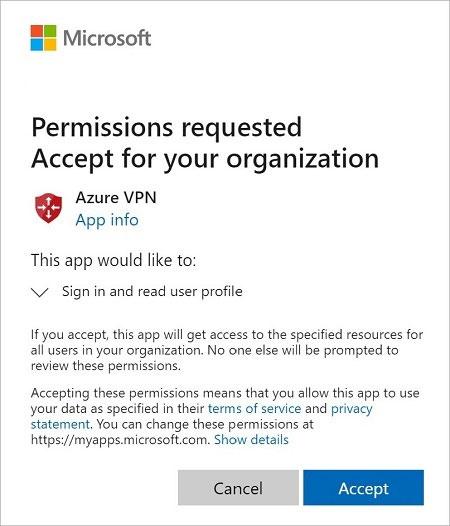
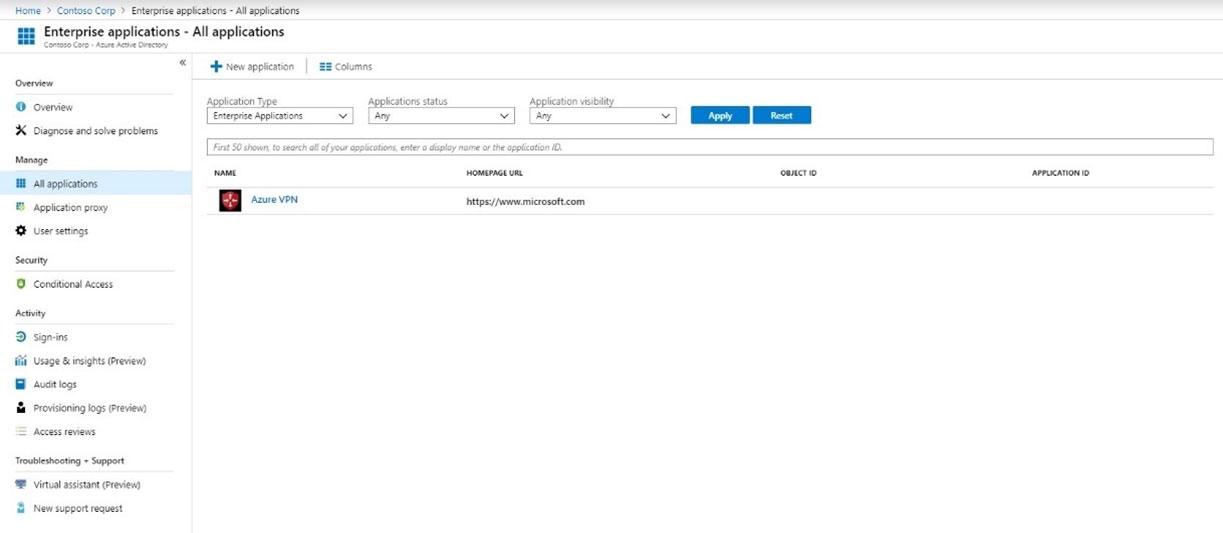
You need to ensure that administrators can use Point-to-Site (P2S) VPN connections to access resources in the virtual network. The connections must be authenticated by Azure Active Directory (Azure AD).
What should you configure? To answer, select the appropriate options in the answer area.
NOTE: Each correct selection is worth one point.
Hot Area: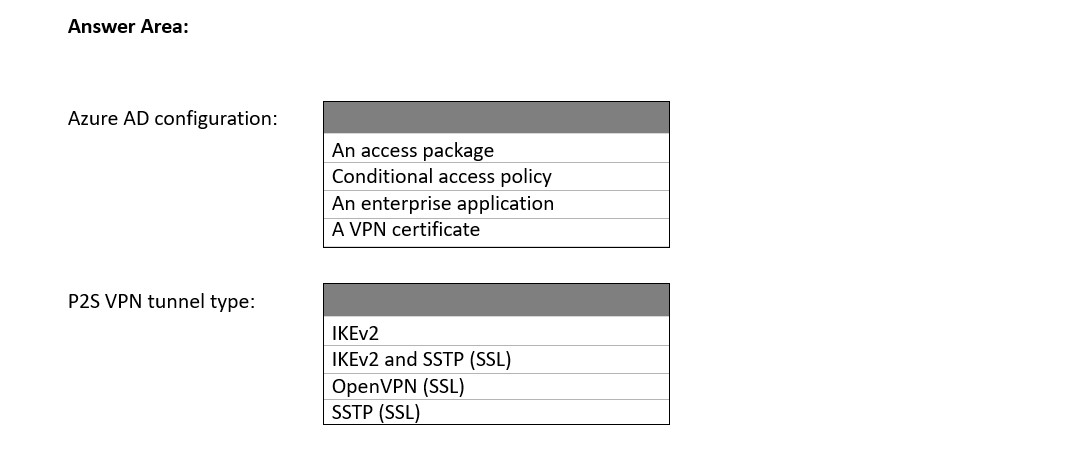
Correct answer: Item 1: C · Item 2: C
QUESTION 10
HOTSPOT -
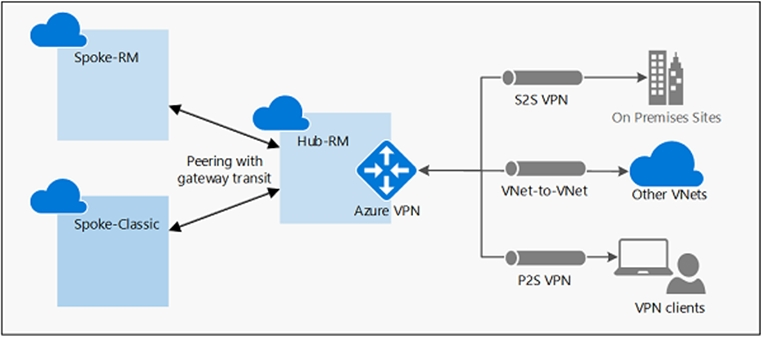
You have the hybrid network shown in the Network Diagram exhibit.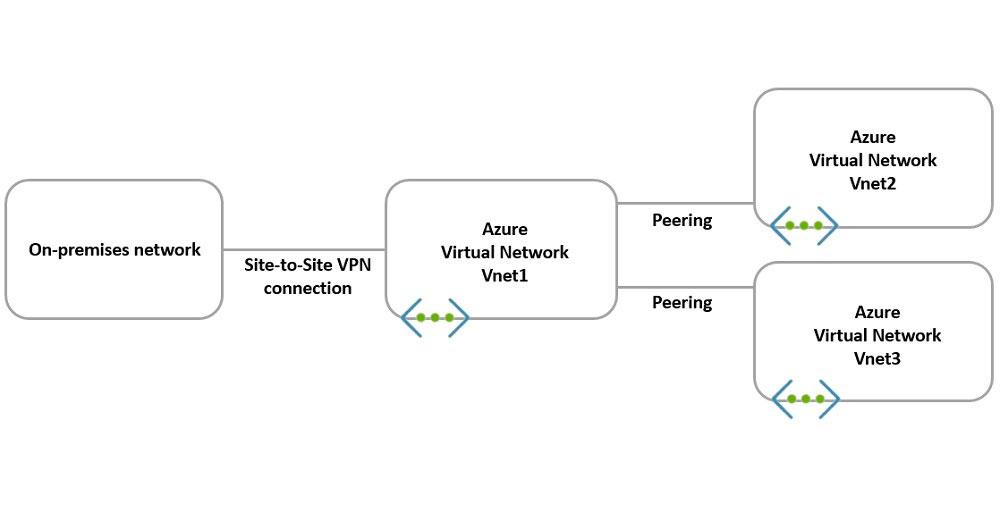
You have a peering connection between Vnet1 and Vnet2 as shown in the Peering-Vnet1-Vnet2 exhibit.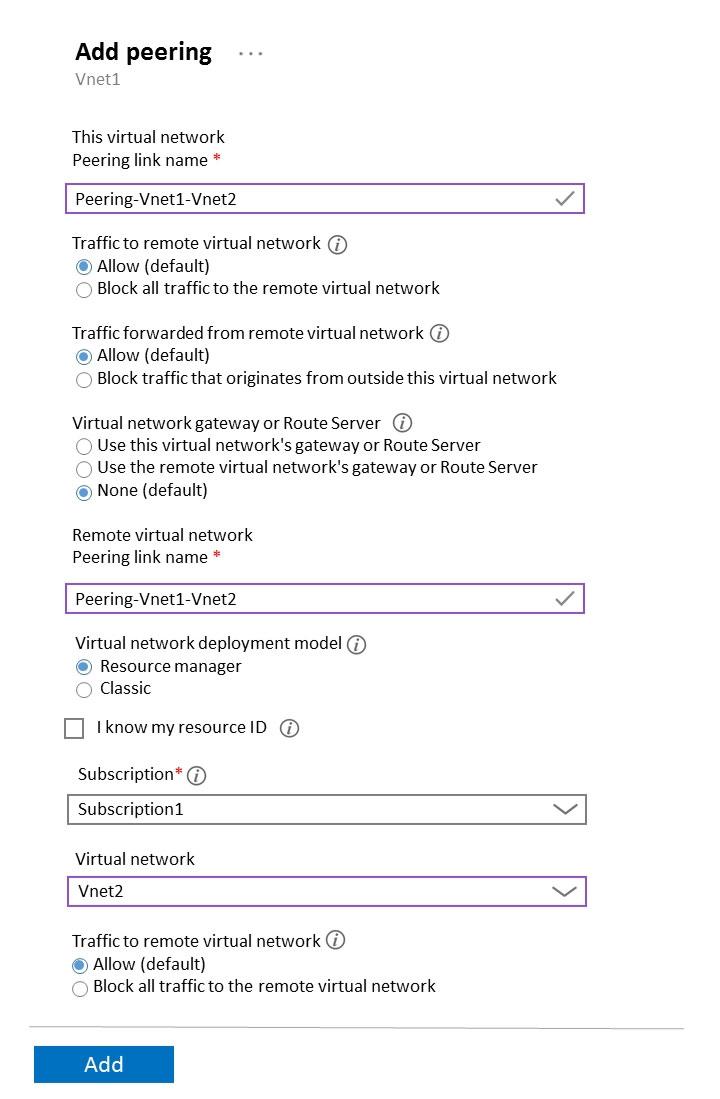
You have a peering connection between Vnet1 and Vnet3 as shown in the Peering-Vnet1-Vnet3 exhibit.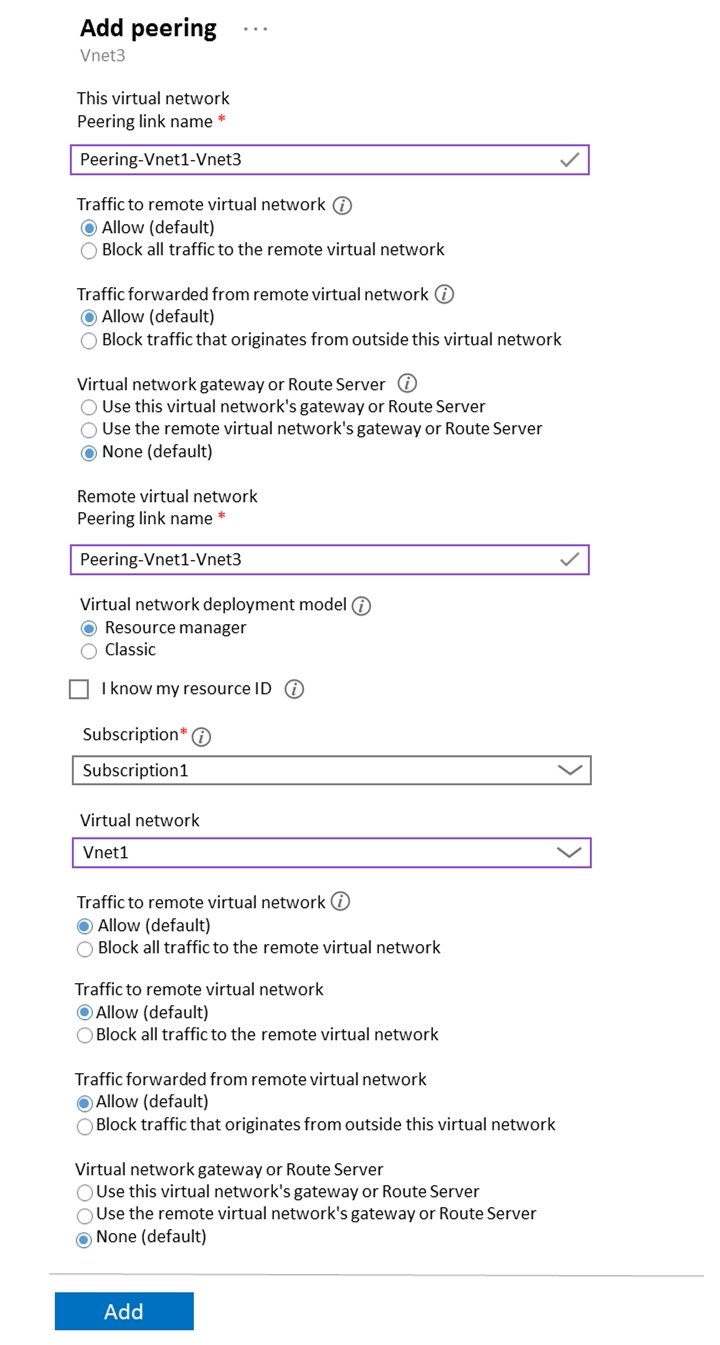
For each of the following statements, select Yes if the statement is true. Otherwise, select No.
NOTE: Each correct selection is worth one point.
Hot Area: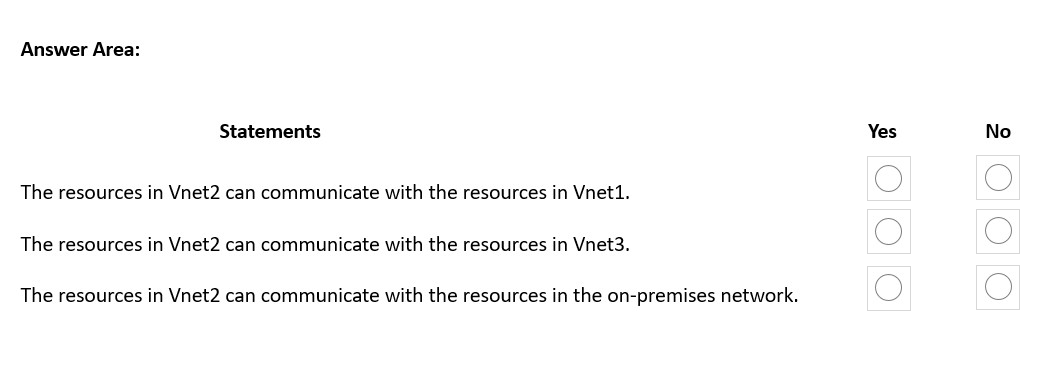
Correct answer: Y, N, N
QUESTION 11
HOTSPOT -
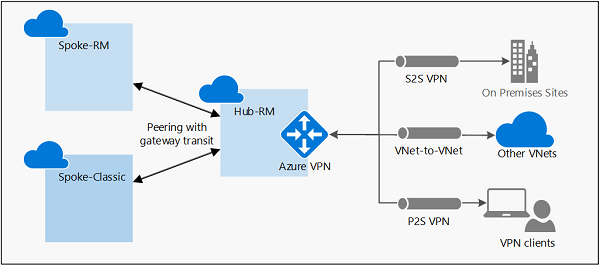
You have the Azure environment shown in the exhibit.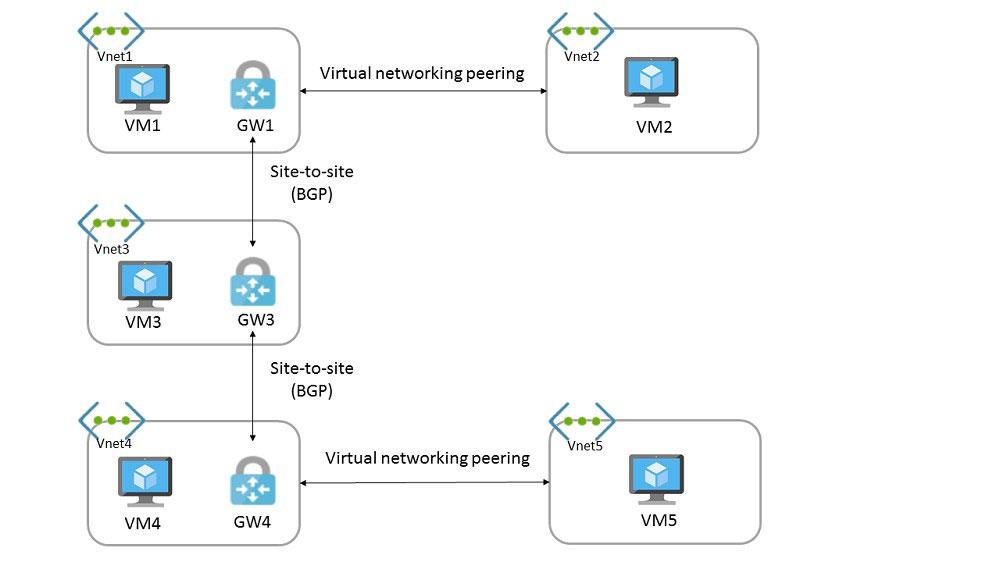
You have virtual network peering between Vnet1 and Vnet2. You have virtual network peering between Vnet4 and Vnet5. The virtual network peering is configured as shown in the following table.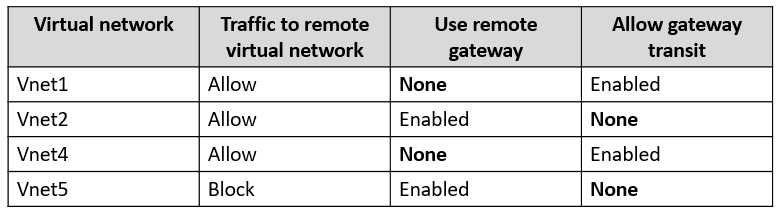
For each of the following statements, select Yes if the statement is true. Otherwise, select No.
Hot Area: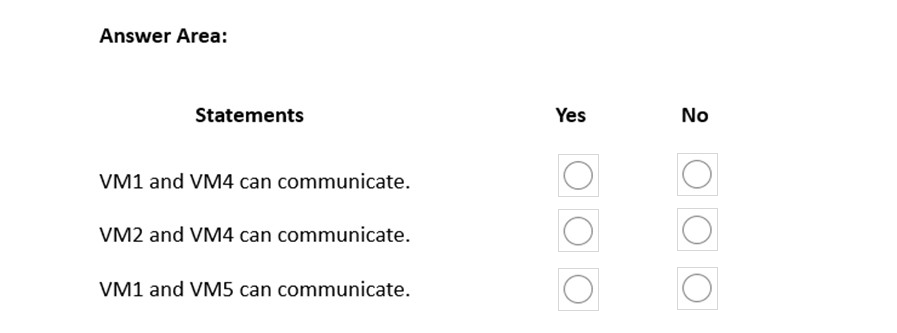
Correct answer: Y, Y, N
QUESTION 12
HOTSPOT -
You have on-premises datacenters in New York and Seattle.
You have an Azure subscription that contains the ExpressRoute circuits shown in the following table.
You need to ensure that all the data sent between the datacenters is routed via the ExpressRoute circuits. The solution must minimize costs.
How should you configure the network? To answer, select the appropriate options in the answer area.
NOTE: Each correct selection is worth one point.
Hot Area: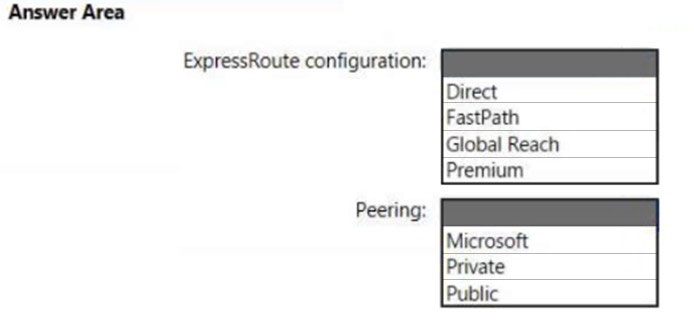
Correct answer: Item 1: C · Item 2: B
QUESTION 13
You have an Azure virtual network named Vnet1 and an on-premises network. The on-premises network has policy-based VPN devices.
In Vnet1, you deploy a virtual network gateway named GW1 that uses a SKU of VpnGw1 and is route-based.
You have a Site-to-Site VPN connection for GW1 as shown in the following exhibit.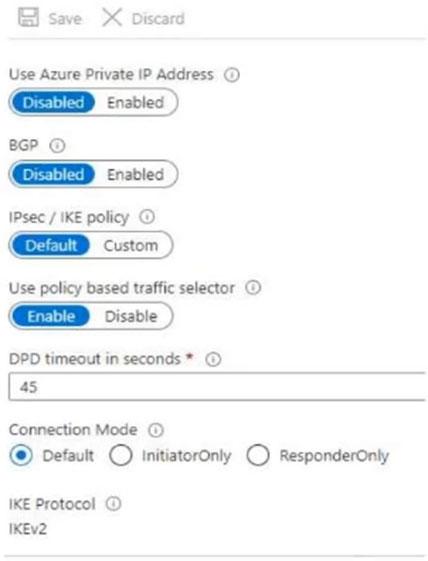
You need to ensure that the on-premises network can connect to the route-based GW1.
What should you do before you create the connection?
Correct answer: D
QUESTION 14
HOTSPOT
-
Your on-premises network contains a VPN device.
You have an Azure subscription that contains a virtual network and a virtual network gateway.
You need to create a Site-to-Site VPN connection that has a custom cryptographic policy.
How should you complete the PowerShell script? To answer, select the appropriate options in the answer area.
NOTE: Each correct selection is worth one point.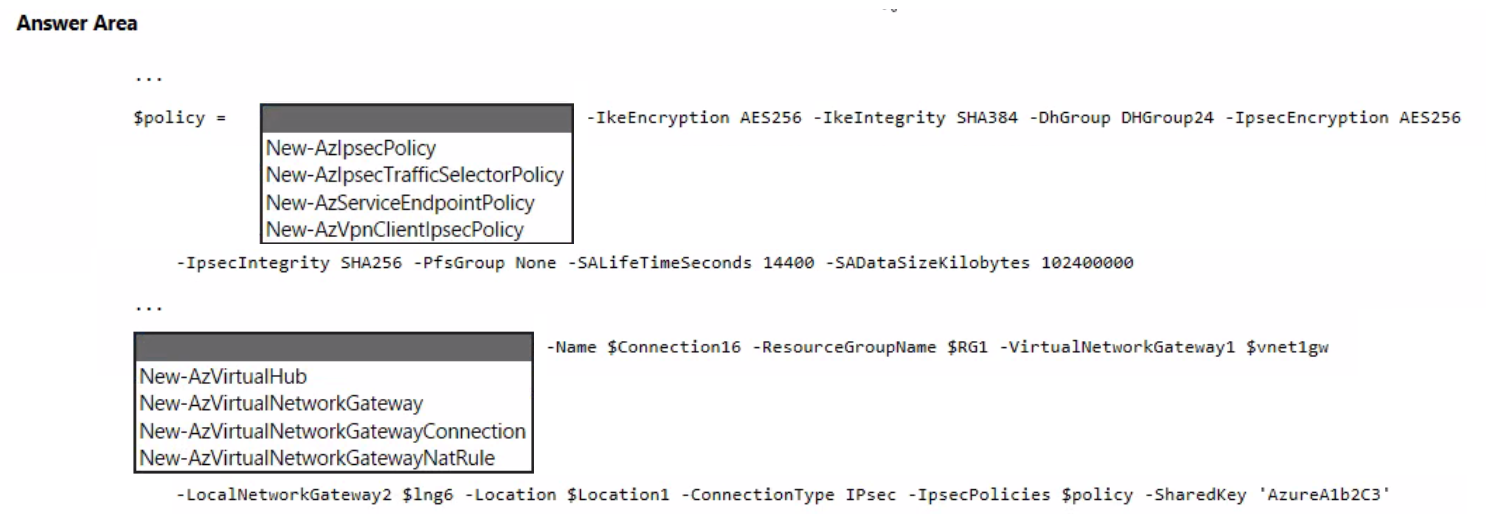
Correct answer:
QUESTION 15
HOTSPOT
-
You have an Azure virtual network and an on-premises datacenter that connect by using a Site-to-Site VPN tunnel.
You need to ensure that all traffic from the virtual network to the internet is routed through the datacenter.
How should you complete the PowerShell script to configure forced tunneling? To answer, select the appropriate options in the answer area.
NOTE: Each correct selection is worth one point.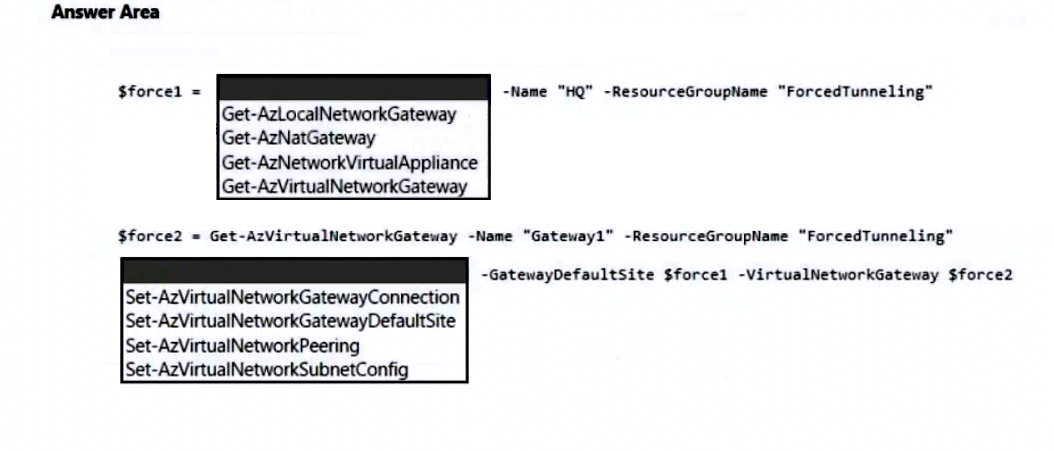
Correct answer:
QUESTION 16
You are planning an Azure deployment that will contain three virtual networks in the East US Azure region as shown in the following table.
A Site-to-Site VPN will connect Vnet1 to your company’s on-premises network.
You need to recommend a solution that ensures that the virtual machines on all the virtual networks can communicate with the on-premises network. The solution must minimize costs.
What should you recommend for Vnet2 and Vnet3?
Correct answer: B
QUESTION 17
Your company has an office in New York.
The company has an Azure subscription that contains the virtual networks shown in the following table.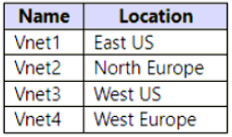
You need to connect the virtual networks to the office by using ExpressRoute. The solution must meet the following requirements:
• The connection must have up to 1 Gbps of bandwidth.
• The office must have access to all the virtual networks.
• Costs must be minimized.
How many ExpressRoute circuits should be provisioned, and which ExpressRoute SKU should you enable?
Correct answer: A
QUESTION 18
You have an Azure subscription that contains a virtual network.
You plan to deploy an Azure VPN gateway and 90 Site-to-Site VPN connections. The solution must meet the following requirements:
• Ensure that the Site-to-Site VPN connections remain available if an Azure datacenter fails.
• Minimize costs.
Which gateway SKU should you specify?
Correct answer: C
QUESTION 19
You have an Azure subscription that contains the resources shown in the following table.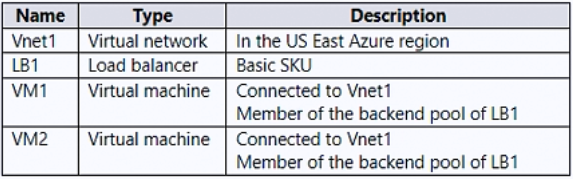
You create a virtual network named Vnet2 in the West US region.
You plan to enable peering between Vnet1 and Vnet2.
You need to ensure that the virtual machines connected to Vnet2 can connect to VM1 and VM2 via LB1.
What should you do?
Correct answer: D
QUESTION 20
DRAG DROP
-
Your on-premises network contains an Active Directory Domain Services (AD DS) domain named contoso.com that has an internal certification authority (CA).
You have an Azure subscription.
You deploy an Azure application gateway named AppGwy1 and perform the following actions:
• Configure an HTTP listener
• Associate a routing rule with the listener
You need to configure AppGwy1 to perform mutual authentication for requests from domain-joined computers to contoso.com.
Which four actions should you perform in sequence? To answer, move the appropriate actions from the list of actions to the answer area and arrange them in the correct order.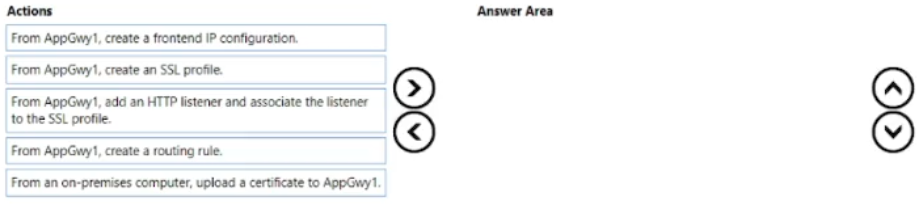
Correct answer: Item 1: A · Item 2: B · Item 3: E · Item 4: C
Choose AZ-700 in Revizo and work through original, question-by-question practice on your iPhone. Review results, revisit what needs attention and keep your next session tied to one specific certification objective.
Practise AZ-700 with RevizoNo. Revizo is an independent iPhone app for certification practice. Refer to the provider's official resources for current exam policies and registration.
Use the exam code to select the matching certification in Revizo, then build short, focused sessions around the areas you want to review.
No. Revizo provides original practice questions for certification study. Use the provider's official objectives, documentation and policies as the source of truth for your preparation.
Use the current Microsoft objectives, documentation and registration guidance as your source of truth. Revizo is designed to support focused practice, not replace the provider's official materials.
Check the official Microsoft exam page for the latest objectives, registration details and policies.