Revizo / Microsoft / DP-300

MICROSOFT CERTIFICATION STUDY GUIDE

DP-300 practice questions.
Prepare with a clearer plan.

Demonstrates ability to administer Azure SQL and other relational databases.

Download Revizo
Revizo certification practice question on iPhone

What to know about DP-300.

Demonstrates ability to administer Azure SQL and other relational databases.

Format
Multiple choice questions
Duration
120 minutes
Passing score
700/1000
Recommended experience
1+ years of database administration

Exam details are based on the available Microsoft catalogue information. Confirm current requirements with the exam provider before booking.

How to prepare for DP-300.

Use the provider's current objectives as your source of truth, then organise your Revizo sessions around the Microsoft technologies, product capabilities and implementation decisions named in the certification. The DP-300 exam is listed as Multiple choice questions; your starting point should reflect 1+ years of database administration.

01

Map the official objectives.

Read the current Microsoft objectives and make a short list of the areas you need to revisit before booking DP-300.

02

Practise one area at a time.

Select DP-300 in Revizo and use focused question sessions to test one topic or decision type at a time, rather than relying on a single long cram session.

03

Review, then repeat.

Use your results to return to incorrect answers, revisit the official material behind them and repeat short DP-300 practice sessions until the gaps are clearer.

FREE PRACTICE PREVIEW

Read the first 20
DP-300 questions.

Review each question, its correct answer and any available source explanation before continuing your certification study in Revizo.

FIRST 20 QUESTIONS

Answers & available explanations

QUESTION 1

You have 20 Azure SQL databases provisioned by using the vCore purchasing model.
You plan to create an Azure SQL Database elastic pool and add the 20 databases.
Which three metrics should you use to size the elastic pool to meet the demands of your workload? Each correct answer presents part of the solution.
NOTE: Each correct selection is worth one point.

  1. AA. total size of all the databases
  2. BB. geo-replication support
  3. CC. number of concurrently peaking databases * peak CPU utilization per database
  4. DD. maximum number of concurrent sessions for all the databases
  5. EE. total number of databases * average CPU utilization per database
Show answer & explanation

Correct answer: A, C, E

Explanation

QUESTION 2

DRAG DROP -
You have SQL Server 2019 on an Azure virtual machine that contains an SSISDB database.
A recent failure causes the master database to be lost.
You discover that all Microsoft SQL Server integration Services (SSIS) packages fail to run on the virtual machine.
Which four actions should you perform in sequence to resolve the issue? To answer, move the appropriate actions from the list of actions to the answer area and arrange them in the correct.
Select and Place:

Item 1

  1. AA. Add a certificate to an Azure key vault
  2. BB. Enable Transparent Data Encryption (TDE)
  3. CC. Encrypt a copy of the master key by using the service master key
  4. DD. Turn on the TRUSTWORTHY property and the CLR property
  5. EE. Attach the SSISDB database
  6. FF. Open the master key for the SSISDB database

Item 2

  1. AA. Add a certificate to an Azure key vault
  2. BB. Enable Transparent Data Encryption (TDE)
  3. CC. Encrypt a copy of the master key by using the service master key
  4. DD. Turn on the TRUSTWORTHY property and the CLR property
  5. EE. Attach the SSISDB database
  6. FF. Open the master key for the SSISDB database

Item 3

  1. AA. Add a certificate to an Azure key vault
  2. BB. Enable Transparent Data Encryption (TDE)
  3. CC. Encrypt a copy of the master key by using the service master key
  4. DD. Turn on the TRUSTWORTHY property and the CLR property
  5. EE. Attach the SSISDB database
  6. FF. Open the master key for the SSISDB database

Item 4

  1. AA. Add a certificate to an Azure key vault
  2. BB. Enable Transparent Data Encryption (TDE)
  3. CC. Encrypt a copy of the master key by using the service master key
  4. DD. Turn on the TRUSTWORTHY property and the CLR property
  5. EE. Attach the SSISDB database
  6. FF. Open the master key for the SSISDB database
Show answer & explanation

Correct answer: Item 1: E · Item 2: D · Item 3: F · Item 4: C

ExplanationStep 1: Attach the SSISDB database
Step 2: Turn on the TRUSTWORTHY property and the CLR property
If you are restoring the SSISDB database to an SQL Server instance where the SSISDB catalog was never created, enable common language runtime (clr)
Step 3: Open the master key for the SSISDB database
Restore the master key by this method if you have the original password that was used to create SSISDB. open master key decryption by password = 'LS1Setup!' --'Password used when creating SSISDB'
Alter Master Key Add encryption by Service Master Key
Step 4: Encrypt a copy of the master key by using the service master key
Reference:
https://docs.microsoft.com/en-us/sql/integration-services/catalog/ssis-catalog

QUESTION 3

You have an Azure SQL database that contains a table named factSales. FactSales contains the columns shown in the following table.
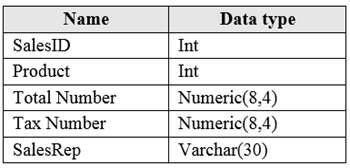
FactSales has 6 billion rows and is loaded nightly by using a batch process. You must provide the greatest reduction in space for the database and maximize performance.
Which type of compression provides the greatest space reduction for the database?

  1. AA. page compression
  2. BB. row compression
  3. CC. columnstore compression
  4. DD. columnstore archival compression
Show answer & explanation

Correct answer: D

Explanation

QUESTION 4

You have a Microsoft SQL Server 2019 database named DB1 that uses the following database-level and instance-level features.
✑ Clustered columnstore indexes
✑ Automatic tuning
✑ Change tracking
✑ PolyBase
You plan to migrate DB1 to an Azure SQL database.
What feature should be removed or replaced before DB1 can be migrated?

  1. AA. Clustered columnstore indexes
  2. BB. PolyBase
  3. CC. Change tracking
  4. DD. Automatic tuning
Show answer & explanation

Correct answer: B

Explanation

QUESTION 5

You have a Microsoft SQL Server 2019 instance in an on-premises datacenter. The instance contains a 4-TB database named DB1.
You plan to migrate DB1 to an Azure SQL Database managed instance.
What should you use to minimize downtime and data loss during the migration?

  1. AA. distributed availability groups
  2. BB. database mirroring
  3. CC. Always On Availability Group
  4. DD. Azure Database Migration Service
Show answer & explanation

Correct answer: D

Explanation

QUESTION 6

HOTSPOT -
You have an on-premises Microsoft SQL Server 2016 server named Server1 that contains a database named DB1.
You need to perform an online migration of DB1 to an Azure SQL Database managed instance by using Azure Database Migration Service.
How should you configure the backup of DB1? To answer, select the appropriate options in the answer area.
NOTE: Each correct selection is worth one point.
Hot Area:

Item 1

  1. AA. Full and log backups only
  2. BB. Full backup only
  3. CC. Log backup only

Item 2

  1. AA. WITH CHECKSUM
  2. BB. WITH NOINIT
  3. CC. WITH UNLOAD
Show answer & explanation

Correct answer: Item 1: A · Item 2: A

ExplanationBox 1: Full and log backups only
Make sure to take every backup on a separate backup media (backup files). Azure Database Migration Service doesn't support backups that are appended to a single backup file. Take full backup and log backups to separate backup files.

Box 2: WITH CHECKSUM -
Azure Database Migration Service uses the backup and restore method to migrate your on-premises databases to SQL Managed Instance. Azure Database
Migration Service only supports backups created using checksum.
Incorrect Answers:
NOINIT Indicates that the backup set is appended to the specified media set, preserving existing backup sets. If a media password is defined for the media set, the password must be supplied. NOINIT is the default.

UNLOAD -
Specifies that the tape is automatically rewound and unloaded when the backup is finished. UNLOAD is the default when a session begins.
Reference:
https://docs.microsoft.com/en-us/azure/dms/known-issues-azure-sql-db-managed-instance-online

QUESTION 7

DRAG DROP -
You have a resource group named App1Dev that contains an Azure SQL Database server named DevServer1. DevServer1 contains an Azure SQL database named DB1. The schema and permissions for DB1 are saved in a Microsoft SQL Server Data Tools (SSDT) database project.
You need to populate a new resource group named App1Test with the DB1 database and an Azure SQL Server named TestServer1. The resources in App1Test must have the same configurations as the resources in App1Dev.
Which four actions should you perform in sequence? To answer, move the appropriate actions from the list of actions to the answer area and arrange them in the correct order.
Select and Place:

Item 1

  1. AA. Change the Active Directory Admin on TestServer1
  2. BB. Change the server name and related variables in the templates
  3. CC. From the database project, deploy the database schema and permissions
  4. DD. Add IP addresses to the firewall
  5. EE. From the Azure portal, export the Azure Resource Manager templates
  6. FF. From the Azure portal, deploy the templates.

Item 2

  1. AA. Change the Active Directory Admin on TestServer1
  2. BB. Change the server name and related variables in the templates
  3. CC. From the database project, deploy the database schema and permissions
  4. DD. Add IP addresses to the firewall
  5. EE. From the Azure portal, export the Azure Resource Manager templates
  6. FF. From the Azure portal, deploy the templates.

Item 3

  1. AA. Change the Active Directory Admin on TestServer1
  2. BB. Change the server name and related variables in the templates
  3. CC. From the database project, deploy the database schema and permissions
  4. DD. Add IP addresses to the firewall
  5. EE. From the Azure portal, export the Azure Resource Manager templates
  6. FF. From the Azure portal, deploy the templates.

Item 4

  1. AA. Change the Active Directory Admin on TestServer1
  2. BB. Change the server name and related variables in the templates
  3. CC. From the database project, deploy the database schema and permissions
  4. DD. Add IP addresses to the firewall
  5. EE. From the Azure portal, export the Azure Resource Manager templates
  6. FF. From the Azure portal, deploy the templates.
Show answer & explanation

Correct answer: Item 1: E · Item 2: B · Item 3: F · Item 4: C

Explanation

QUESTION 8

HOTSPOT -
You have an Azure Synapse Analytics dedicated SQL pool named Pool1 and an Azure Data Lake Storage Gen2 account named Account1.
You plan to access the files in Account1 by using an external table.
You need to create a data source in Pool1 that you can reference when you create the external table.
How should you complete the Transact-SQL statement? To answer, select the appropriate options in the answer area.
NOTE: Each correct selection is worth one point.
Hot Area:
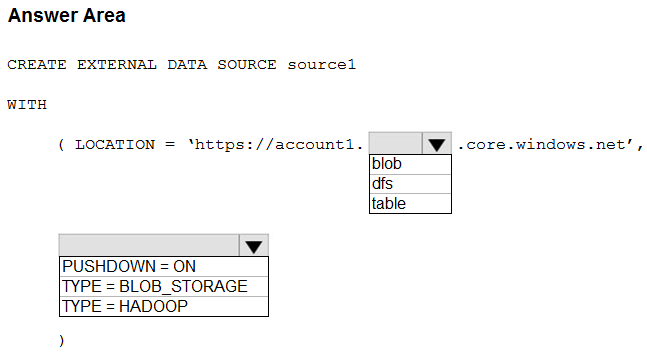
Item 1

  1. AA. blob
  2. BB. dfs
  3. CC. table

Item 2

  1. AA. PUSHDOWN = ON
  2. BB. TYPE = BLOB_STORAGE
  3. CC. TYPE = HADOOP
Show answer & explanation

Correct answer: Item 1: B · Item 2: C

ExplanationBox 1: dfs -
For Azure Data Lake Store Gen 2 used the following syntax:
http[s] <storage_account>.dfs.core.windows.net/<container>/subfolders
Incorrect:
Not blob: blob is used for Azure Blob Storage. Syntax:
http[s] <storage_account>.blob.core.windows.net/<container>/subfolders

Box 2: TYPE = HADOOP -
Syntax for CREATE EXTERNAL DATA SOURCE.
External data sources with TYPE=HADOOP are available only in dedicated SQL pools.
CREATE EXTERNAL DATA SOURCE <data_source_name>

WITH -
( LOCATION = '<prefix>://<path>'
[, CREDENTIAL = <database scoped credential> ]
, TYPE = HADOOP
)
[;]
Reference:
https://docs.microsoft.com/en-us/azure/synapse-analytics/sql/develop-tables-external-tables

QUESTION 9

HOTSPOT -
You plan to develop a dataset named Purchases by using Azure Databricks. Purchases will contain the following columns:
✑ ProductID
✑ ItemPrice
✑ LineTotal
✑ Quantity
✑ StoreID
✑ Minute
✑ Month
✑ Hour
✑ Year
✑ Day
You need to store the data to support hourly incremental load pipelines that will vary for each StoreID. The solution must minimize storage costs.
How should you complete the code? To answer, select the appropriate options in the answer area.
NOTE: Each correct selection is worth one point.
Hot Area:
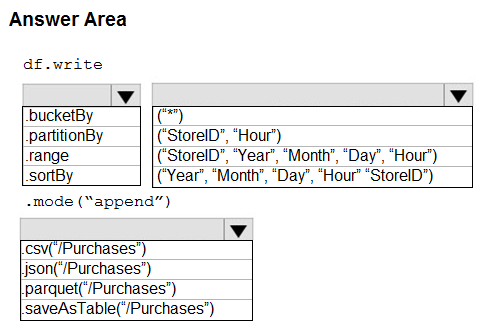
Item 1

  1. AA. .bucketBy
  2. BB. .partitionBy
  3. CC. .range
  4. DD. .sortBy

Item 2

  1. AA. ("*")
  2. BB. ("StoreID", "Hour")
  3. CC. ("StoreID", "Year", "Month", "Day", "Hour")
  4. DD. ("Year", "Month", "Day", "Hour", "StoreID")

Item 3

  1. AA. .csv("/Purchases")
  2. BB. .json("/Purchases")
  3. CC. .parquet("/Purchases")
  4. DD. .saveAsTable("/Purchases")
Show answer & explanation

Correct answer: Item 1: B · Item 2: D · Item 3: C

ExplanationBox 1: .partitionBy -
Example:
df.write.partitionBy('y','m','d')
.mode(SaveMode.Append)
.parquet('/data/hive/warehouse/db_name.db/' + tableName)
Box 2: ('Year','Month','Day','Hour','StoreID')
Box 3: .parquet('/Purchases')
Reference:
https://intellipaat.com/community/11744/how-to-partition-and-write-dataframe-in-spark-without-deleting-partitions-with-no-new-data

QUESTION 10

You are designing a streaming data solution that will ingest variable volumes of data.
You need to ensure that you can change the partition count after creation.
Which service should you use to ingest the data?

  1. AA. Azure Event Hubs Standard
  2. BB. Azure Stream Analytics
  3. CC. Azure Data Factory
  4. DD. Azure Event Hubs Dedicated
Show answer & explanation

Correct answer: D

Explanation

QUESTION 11

HOTSPOT -
You are building a database in an Azure Synapse Analytics serverless SQL pool.
You have data stored in Parquet files in an Azure Data Lake Storage Gen2 container.
Records are structured as shown in the following sample.
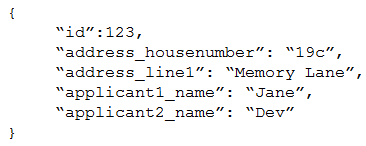
The records contain two applicants at most.
You need to build a table that includes only the address fields.
How should you complete the Transact-SQL statement? To answer, select the appropriate options in the answer area.
NOTE: Each correct selection is worth one point.
Hot Area:

Item 1

  1. AA. CREATE EXTERNAL TABLE
  2. BB. CREATE TABLE
  3. CC. CREATE VIEW

Item 2

  1. AA. CROSS APPLY
  2. BB. OPENJSON
  3. CC. OPENROWSET
Show answer & explanation

Correct answer: Item 1: A · Item 2: C

ExplanationBox 1: CREATE EXTERNAL TABLE -
An external table points to data located in Hadoop, Azure Storage blob, or Azure Data Lake Storage. External tables are used to read data from files or write data to files in Azure Storage. With Synapse SQL, you can use external tables to read external data using dedicated SQL pool or serverless SQL pool.
Syntax:
CREATE EXTERNAL TABLE { database_name.schema_name.table_name | schema_name.table_name | table_name }
( <column_definition> [ ,...n ] )
WITH (
LOCATION = 'folder_or_filepath',
DATA_SOURCE = external_data_source_name,
FILE_FORMAT = external_file_format_name

Box 2. OPENROWSET -
When using serverless SQL pool, CETAS is used to create an external table and export query results to Azure Storage Blob or Azure Data Lake Storage Gen2.
Example:

AS -
SELECT decennialTime, stateName, SUM(population) AS population

FROM -
OPENROWSET(BULK 'https://azureopendatastorage.blob.core.windows.net/censusdatacontainer/release/us_population_county/year=*/*.parquet',
FORMAT='PARQUET') AS [r]
GROUP BY decennialTime, stateName

GO -
Reference:
https://docs.microsoft.com/en-us/azure/synapse-analytics/sql/develop-tables-external-tables

QUESTION 12

You have an Azure Synapse Analytics Apache Spark pool named Pool1.
You plan to load JSON files from an Azure Data Lake Storage Gen2 container into the tables in Pool1. The structure and data types vary by file.
You need to load the files into the tables. The solution must maintain the source data types.
What should you do?

  1. AA. Load the data by using PySpark.
  2. BB. Load the data by using the OPENROWSET Transact-SQL command in an Azure Synapse Analytics serverless SQL pool.
  3. CC. Use a Get Metadata activity in Azure Data Factory.
  4. DD. Use a Conditional Split transformation in an Azure Synapse data flow.
Show answer & explanation

Correct answer: A

ExplanationSynapse notebooks support four Apache Spark languages:
PySpark (Python)
Spark (Scala)

Spark SQL -
.NET Spark (C#)
Note: Bring data to a notebook.
You can load data from Azure Blob Storage, Azure Data Lake Store Gen 2, and SQL pool as shown in the code samples below.
Read a CSV from Azure Data Lake Store Gen2 as a Spark DataFrame. from pyspark.sql import SparkSession from pyspark.sql.types import * account_name = 'Your account name' container_name = 'Your container name' relative_path = 'Your path' adls_path = 'abfss://%s@%s.dfs.core.windows.net/%s' % (container_name, account_name, relative_path) df1 = spark.read.option('header', 'true') \
.option('delimiter', ',') \
.csv(adls_path + '/Testfile.csv')
Reference:
https://docs.microsoft.com/en-us/azure/synapse-analytics/spark/apache-spark-development-using-notebooks

QUESTION 13

You are designing a date dimension table in an Azure Synapse Analytics dedicated SQL pool. The date dimension table will be used by all the fact tables.
Which distribution type should you recommend to minimize data movement?

  1. AA. HASH
  2. BB. REPLICATE
  3. CC. ROUND_ROBIN
Show answer & explanation

Correct answer: B

ExplanationA replicated table has a full copy of the table available on every Compute node. Queries run fast on replicated tables since joins on replicated tables don't require data movement. Replication requires extra storage, though, and isn't practical for large tables.
Incorrect Answers:
C: A round-robin distributed table distributes table rows evenly across all distributions. The assignment of rows to distributions is random. Unlike hash-distributed tables, rows with equal values are not guaranteed to be assigned to the same distribution.
As a result, the system sometimes needs to invoke a data movement operation to better organize your data before it can resolve a query.
Reference:
https://docs.microsoft.com/en-us/azure/synapse-analytics/sql-data-warehouse/sql-data-warehouse-tables-distribute

QUESTION 14

HOTSPOT -
From a website analytics system, you receive data extracts about user interactions such as downloads, link clicks, form submissions, and video plays.
The data contains the following columns:
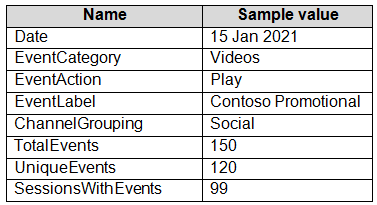
You need to design a star schema to support analytical queries of the data. The star schema will contain four tables including a date dimension.
To which table should you add each column? To answer, select the appropriate options in the answer area.
NOTE: Each correct selection is worth one point.
Hot Area:

Item 1

  1. AA. DimChannel
  2. BB. DimDate
  3. CC. DimEvent
  4. DD. FactEvents

Item 2

  1. AA. DimChannel
  2. BB. DimDate
  3. CC. DimEvent
  4. DD. FactEvents

Item 3

  1. AA. DimChannel
  2. BB. DimDate
  3. CC. DimEvent
  4. DD. FactEvents
Show answer & explanation

Correct answer: Item 1: C · Item 2: A · Item 3: D

ExplanationBox 1: DimEvent -

Box 2: DimChannel -
Dimension tables describe business entities ג€' the things you model. Entities can include products, people, places, and concepts including time itself. The most consistent table you'll find in a star schema is a date dimension table. A dimension table contains a key column (or columns) that acts as a unique identifier, and descriptive columns.

Box 3: FactEvents -
Fact tables store observations or events, and can be sales orders, stock balances, exchange rates, temperatures, etc.
Reference:
https://docs.microsoft.com/en-us/power-bi/guidance/star-schema

QUESTION 15

DRAG DROP -
You plan to create a table in an Azure Synapse Analytics dedicated SQL pool.
Data in the table will be retained for five years. Once a year, data that is older than five years will be deleted.
You need to ensure that the data is distributed evenly across partitions. The solutions must minimize the amount of time required to delete old data.
How should you complete the Transact-SQL statement? To answer, drag the appropriate values to the correct targets. Each value may be used once, more than once, or not at all.
You may need to drag the split bar between panes or scroll to view content.
NOTE: Each correct selection is worth one point.
Select and Place:
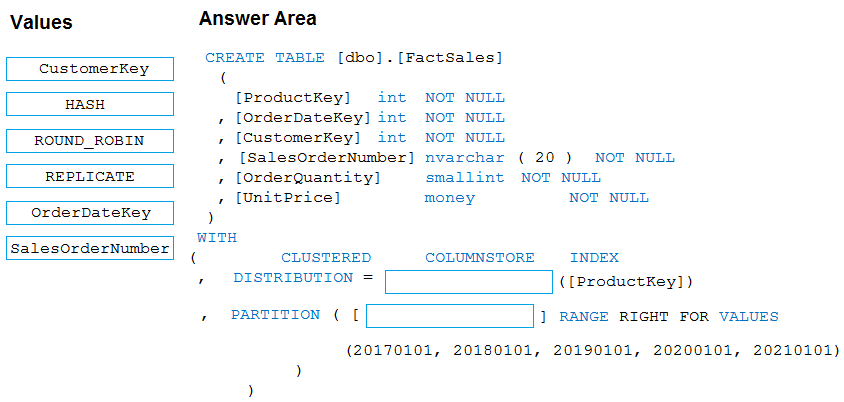
Item 1

  1. AA. CustomerKey
  2. BB. HASH
  3. CC. ROUND_ROBIN
  4. DD. REPLICATE
  5. EE. OrderDateKey
  6. FF. SalesOrderNumber

Item 2

  1. AA. CustomerKey
  2. BB. HASH
  3. CC. ROUND_ROBIN
  4. DD. REPLICATE
  5. EE. OrderDateKey
  6. FF. SalesOrderNumber
Show answer & explanation

Correct answer: Item 1: B · Item 2: E

ExplanationBox 1: HASH -

Box 2: OrderDateKey -
In most cases, table partitions are created on a date column.
A way to eliminate rollbacks is to use Metadata Only operations like partition switching for data management. For example, rather than execute a DELETE statement to delete all rows in a table where the order_date was in October of 2001, you could partition your data early. Then you can switch out the partition with data for an empty partition from another table.
Reference:
https://docs.microsoft.com/en-us/sql/t-sql/statements/create-table-azure-sql-data-warehouse https://docs.microsoft.com/en-us/azure/synapse-analytics/sql/best-practices-dedicated-sql-pool

QUESTION 16

You have an Azure Synapse Analytics workspace named WS1 that contains an Apache Spark pool named Pool1.
You plan to create a database named DB1 in Pool1.
You need to ensure that when tables are created in DB1, the tables are available automatically as external tables to the built-in serverless SQL pool.
Which format should you use for the tables in DB1?

  1. AA. JSON
  2. BB. CSV
  3. CC. Parquet
  4. DD. ORC
Show answer & explanation

Correct answer: C

ExplanationServerless SQL pool can automatically synchronize metadata from Apache Spark. A serverless SQL pool database will be created for each database existing in serverless Apache Spark pools.
For each Spark external table based on Parquet and located in Azure Storage, an external table is created in a serverless SQL pool database. As such, you can shut down your Spark pools and still query Spark external tables from serverless SQL pool.
Reference:
https://docs.microsoft.com/en-us/azure/synapse-analytics/sql/develop-storage-files-spark-tables

QUESTION 17

You are designing an anomaly detection solution for streaming data from an Azure IoT hub. The solution must meet the following requirements:
✑ Send the output to an Azure Synapse.
✑ Identify spikes and dips in time series data.
✑ Minimize development and configuration effort.
Which should you include in the solution?

  1. AA. Azure SQL Database
  2. BB. Azure Databricks
  3. CC. Azure Stream Analytics
Show answer & explanation

Correct answer: C

ExplanationAnomalies can be identified by routing data via IoT Hub to a built-in ML model in Azure Stream Analytics
Reference:
https://docs.microsoft.com/en-us/learn/modules/data-anomaly-detection-using-azure-iot-hub/ https://docs.microsoft.com/en-us/azure/stream-analytics/azure-synapse-analytics-output

QUESTION 18

You are creating a new notebook in Azure Databricks that will support R as the primary language but will also support Scala and SQL.
Which switch should you use to switch between languages?

  1. AA. \\[]
  2. BB. %
  3. CC. \\[]
  4. DD. @
Show answer & explanation

Correct answer: B

ExplanationYou can override the default language by specifying the language magic command %<language> at the beginning of a cell. The supported magic commands are:
%python, %r, %scala, and %sql.
Reference:
https://docs.microsoft.com/en-us/azure/databricks/notebooks/notebooks-use

QUESTION 19

DRAG DROP -
You are creating a managed data warehouse solution on Microsoft Azure.
You must use PolyBase to retrieve data from Azure Blob storage that resides in parquet format and load the data into a large table called FactSalesOrderDetails.
You need to configure Azure Synapse Analytics to receive the data.
Which four actions should you perform in sequence? To answer, move the appropriate actions from the list of actions to the answer area and arrange them in the correct order.
Select and Place:

Item 1

  1. AA. Create an external data source for Azure Blob storage.
  2. BB. Create a master key on database.
  3. CC. Enable Transparent Data Encryption.
  4. DD. Create the external table FactSalesOrderDetails.
  5. EE. Load the data to a staging table.
  6. FF. Create an external file format to map the parquet files.

Item 2

  1. AA. Create an external data source for Azure Blob storage.
  2. BB. Create a master key on database.
  3. CC. Enable Transparent Data Encryption.
  4. DD. Create the external table FactSalesOrderDetails.
  5. EE. Load the data to a staging table.
  6. FF. Create an external file format to map the parquet files.

Item 3

  1. AA. Create an external data source for Azure Blob storage.
  2. BB. Create a master key on database.
  3. CC. Enable Transparent Data Encryption.
  4. DD. Create the external table FactSalesOrderDetails.
  5. EE. Load the data to a staging table.
  6. FF. Create an external file format to map the parquet files.

Item 4

  1. AA. Create an external data source for Azure Blob storage.
  2. BB. Create a master key on database.
  3. CC. Enable Transparent Data Encryption.
  4. DD. Create the external table FactSalesOrderDetails.
  5. EE. Load the data to a staging table.
  6. FF. Create an external file format to map the parquet files.
Show answer & explanation

Correct answer: Item 1: B · Item 2: A · Item 3: F · Item 4: D

ExplanationTo query the data in your Hadoop data source, you must define an external table to use in Transact-SQL queries. The following steps describe how to configure the external table.
Step 1: Create a master key on database.
1. Create a master key on the database. The master key is required to encrypt the credential secret.
(Create a database scoped credential for Azure blob storage.)
Step 2: Create an external data source for Azure Blob storage.
2. Create an external data source with CREATE EXTERNAL DATA SOURCE..
Step 3: Create an external file format to map the parquet files.
3. Create an external file format with CREATE EXTERNAL FILE FORMAT.
Step 4. Create an external table FactSalesOrderDetails
4. Create an external table pointing to data stored in Azure storage with CREATE EXTERNAL TABLE.
Reference:
https://docs.microsoft.com/en-us/sql/relational-databases/polybase/polybase-configure-azure-blob-storage

QUESTION 20

HOTSPOT -
You configure version control for an Azure Data Factory instance as shown in the following exhibit.
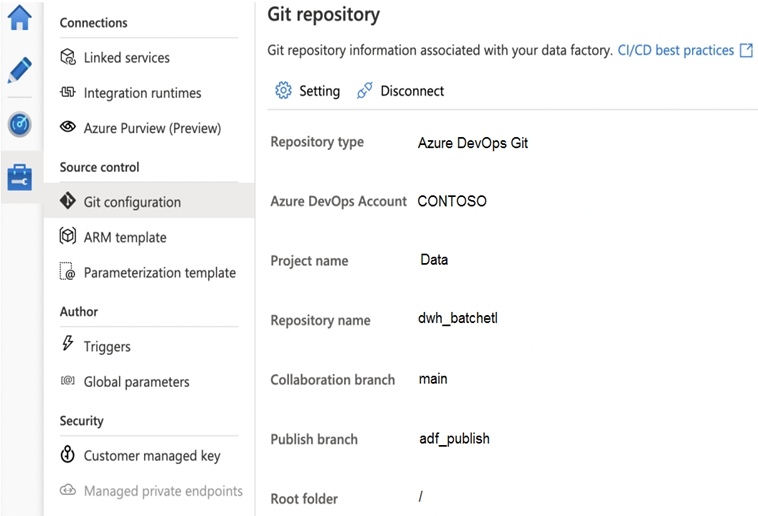
Use the drop-down menus to select the answer choice that completes each statement based on the information presented in the graphic.
NOTE: Each correct selection is worth one point.
Hot Area:

Item 1

  1. AA. /
  2. BB. adf_publish
  3. CC. main
  4. DD. Parameterization template

Item 2

  1. AA. /contososales
  2. BB. /dwh_batchetl/adf_publish/contososales
  3. CC. /main
Show answer & explanation

Correct answer: Item 1: B · Item 2: B

ExplanationBox 1: adf_publish -
By default, data factory generates the Resource Manager templates of the published factory and saves them into a branch called adf_publish. To configure a custom publish branch, add a publish_config.json file to the root folder in the collaboration branch. When publishing, ADF reads this file, looks for the field publishBranch, and saves all Resource Manager templates to the specified location. If the branch doesn't exist, data factory will automatically create it. And example of what this file looks like is below:
{
'publishBranch': 'factory/adf_publish'
}
Box 2: /dwh_barchlet/ adf_publish/contososales
RepositoryName: Your Azure Repos code repository name. Azure Repos projects contain Git repositories to manage your source code as your project grows. You can create a new repository or use an existing repository that's already in your project.
Reference:
https://docs.microsoft.com/en-us/azure/data-factory/source-control

Build a focused DP-300 practice routine.

Choose DP-300 in Revizo and work through original, question-by-question practice on your iPhone. Review results, revisit what needs attention and keep your next session tied to one specific certification objective.

Practise DP-300 with Revizo

DP-300 practice questions.

Is Revizo the official Microsoft exam?

No. Revizo is an independent iPhone app for certification practice. Refer to the provider's official resources for current exam policies and registration.

How should I use these DP-300 practice questions?

Use the exam code to select the matching certification in Revizo, then build short, focused sessions around the areas you want to review.

Are Revizo questions copied from live examinations?

No. Revizo provides original practice questions for certification study. Use the provider's official objectives, documentation and policies as the source of truth for your preparation.

What should I use alongside DP-300 practice questions?

Use the current Microsoft objectives, documentation and registration guidance as your source of truth. Revizo is designed to support focused practice, not replace the provider's official materials.

Where can I confirm current DP-300 requirements?

Check the official Microsoft exam page for the latest objectives, registration details and policies.