Revizo / Microsoft / DP-900

MICROSOFT CERTIFICATION STUDY GUIDE

DP-900 practice questions.
Prepare with a clearer plan.

Validates foundational knowledge of core data concepts and Azure data services.

Download Revizo
Revizo certification practice question on iPhone

What to know about DP-900.

Validates foundational knowledge of core data concepts and Azure data services.

Format
Multiple choice questions
Duration
60 minutes
Passing score
700/1000
Recommended experience
No technical background required

Exam details are based on the available Microsoft catalogue information. Confirm current requirements with the exam provider before booking.

How to prepare for DP-900.

Use the provider's current objectives as your source of truth, then organise your Revizo sessions around the Microsoft technologies, product capabilities and implementation decisions named in the certification. The DP-900 exam is listed as Multiple choice questions; your starting point should reflect No technical background required.

01

Map the official objectives.

Read the current Microsoft objectives and make a short list of the areas you need to revisit before booking DP-900.

02

Practise one area at a time.

Select DP-900 in Revizo and use focused question sessions to test one topic or decision type at a time, rather than relying on a single long cram session.

03

Review, then repeat.

Use your results to return to incorrect answers, revisit the official material behind them and repeat short DP-900 practice sessions until the gaps are clearer.

FREE PRACTICE PREVIEW

Read the first 20
DP-900 questions.

Review each question, its correct answer and any available source explanation before continuing your certification study in Revizo.

FIRST 20 QUESTIONS

Answers & available explanations

QUESTION 1

HOTSPOT -
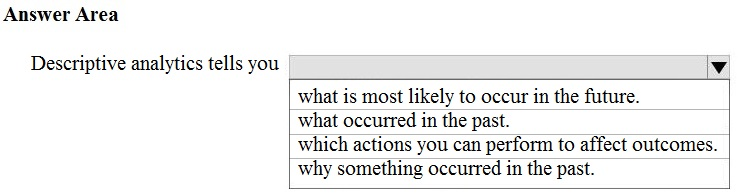
To complete the sentence, select the appropriate option in the answer area.
Hot Area:
    Show answer & explanation

    Correct answer: B

    ExplanationReference:
    https://demand-planning.com/2020/01/20/the-differences-between-descriptive-diagnostic-predictive-cognitive-analytics/

    QUESTION 2

    HOTSPOT -
    For each of the following statements, select Yes if the statement is true. Otherwise, select No.
    NOTE: Each correct selection is worth one point.
    Hot Area:
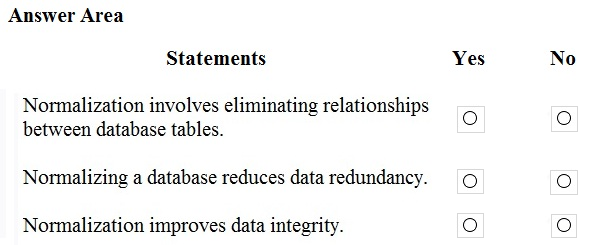
    1. ANormalization involves eliminating relationships between database tables.
    2. BNormalizing a database reduces data redundancy.
    3. CNormalization improves data integrity.
    Show answer & explanation

    Correct answer: N, Y, Y

    ExplanationReference:
    https://www.sqlshack.com/what-is-database-normalization-in-sql-server/

    QUESTION 3

    HOTSPOT -
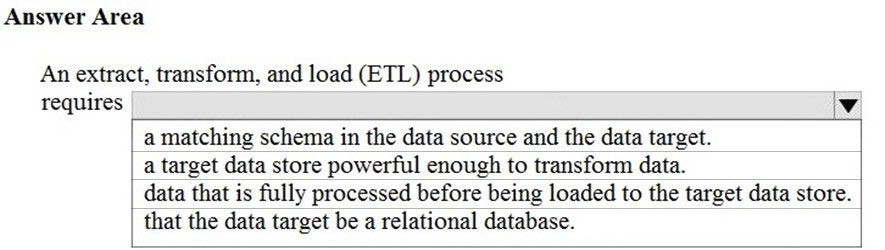
    To complete the sentence, select the appropriate option in the answer area.
    Hot Area:
      Show answer & explanation

      Correct answer: C

      ExplanationExtract, transform, and load (ETL) is a data pipeline used to collect data from various sources, transform the data according to business rules, and load it into a destination data store.
      Reference:
      https://docs.microsoft.com/en-us/azure/architecture/data-guide/relational-data/etl

      QUESTION 4

      HOTSPOT -
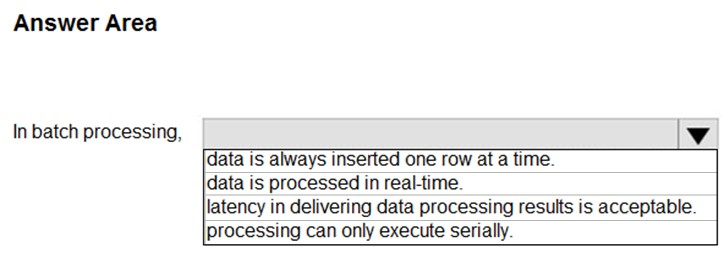
      To complete the sentence, select the appropriate option in the answer area.
      Hot Area:
        Show answer & explanation

        Correct answer: C

        ExplanationWhen to use batch processing.
        You might expect latencies when using batch processing. For many situations, however, this type of delay before the transfer of data begins is not a big issue - the processes that use this function are not mission critical at the exact moment.
        Reference:
        https://www.bmc.com/blogs/what-is-batch-processing-batch-processing-explained/

        QUESTION 5

        HOTSPOT -
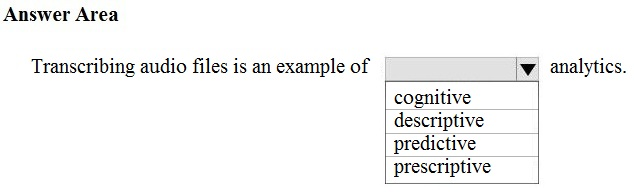
        To complete the sentence, select the appropriate option in the answer area.
        Hot Area:
          Show answer & explanation

          Correct answer: A

          ExplanationReference:
          https://azure.microsoft.com/en-us/services/cognitive-services/speech-services/

          QUESTION 6

          DRAG DROP -
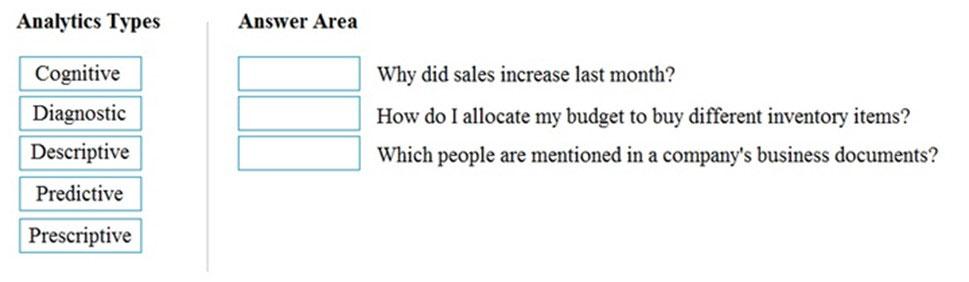
          Match the types of analytics that can be used to answer the business questions.
          To answer, drag the appropriate analytics type from the column on the left to its question on the right. Each analytics type may be used once, more than once, or not at all.
          NOTE: Each correct match is worth one point.
          Select and Place:
          Item 1

          1. AA. Cognitive
          2. BB. Diagnostic
          3. CC. Descriptive
          4. DD. Predictive
          5. EE. Prescriptive

          Item 2

          1. AA. Cognitive
          2. BB. Diagnostic
          3. CC. Descriptive
          4. DD. Predictive
          5. EE. Prescriptive

          Item 3

          1. AA. Cognitive
          2. BB. Diagnostic
          3. CC. Descriptive
          4. DD. Predictive
          5. EE. Prescriptive
          Show answer & explanation

          Correct answer: Item 1: B · Item 2: D · Item 3: C
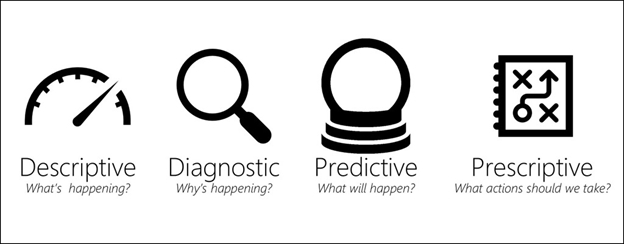
          ExplanationBox 1: Diagnostic -
          Diagnostic Analytics: At this stage you can begin to answer some of those why questions. Historical data can begin to be measured against other data to answer the question of why something happened in the past. This is the process of gathering and interpreting different data sets to identify anomalies, detect patters, and determine relationships.

          Box 2: Prescriptive -
          Prescriptive analytics is a combination of data, mathematical models, and various business rules to infer actions to influence future desired outcomes.
          Predictive analytics, broadly speaking, is a category of business intelligence that uses descriptive and predictive variables from the past to analyze and identify the likelihood of an unknown future outcome

          Box 3: Descriptive -
          ✑ Generally speaking, data analytics comes in four types:
          ✑ Descriptive, to answer the question: What's happening?
          ✑ Diagnostic, to answer the question: Why's happening?
          ✑ Predictive, to answer the question: What will happen?
          ✑ Prescriptive, to answer the question: What actions should we take?

          Reference:
          https://demand-planning.com/2020/01/20/the-differences-between-descriptive-diagnostic-predictive-cognitive-analytics/ https://azure.microsoft.com/en-us/blog/answering-whats-happening-whys-happening-and-what-will-happen-with-iot-analytics/

          QUESTION 7

          HOTSPOT -
          You have the following JSON document.
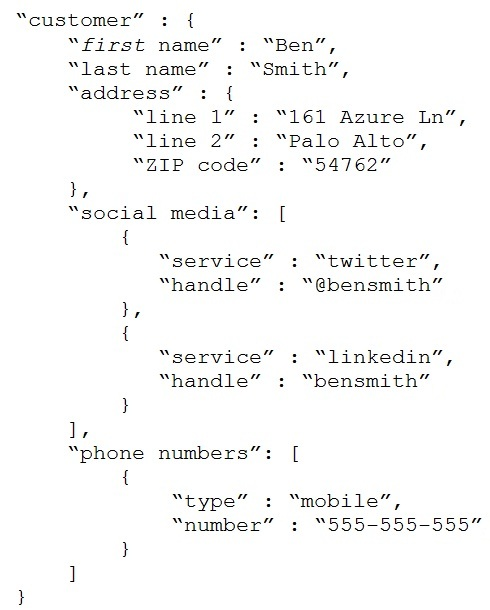
          Use the drop-down menus to select the answer choice that completes each statement based on the information presented in the JSON document.
          NOTE: Each correct selection is worth one point.
          Hot Area:
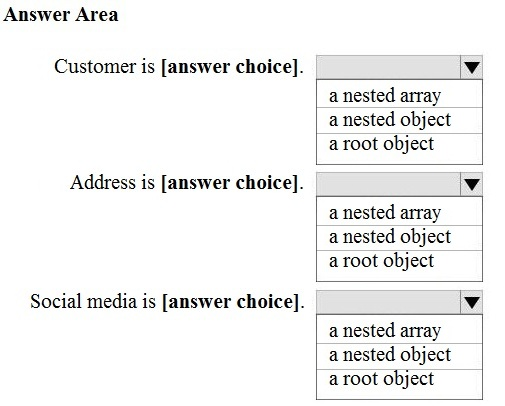
          Item 1

          1. AA. a nested array
          2. BB. a nested object
          3. CC. a root object

          Item 2

          1. AA. a nested array
          2. BB. a nested object
          3. CC. a root object

          Item 3

          1. AA. a nested array
          2. BB. a nested object
          3. CC. a root object
          Show answer & explanation

          Correct answer: Item 1: C · Item 2: B · Item 3: A

          ExplanationReference:
          https://www.w3schools.com/js/js_json_arrays.asp
          https://www.w3schools.com/js/js_json_objects.asp

          QUESTION 8

          HOTSPOT -
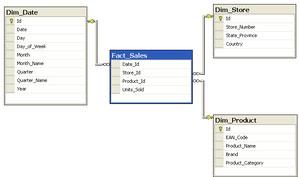
          You are reviewing the data model shown in the following exhibit.
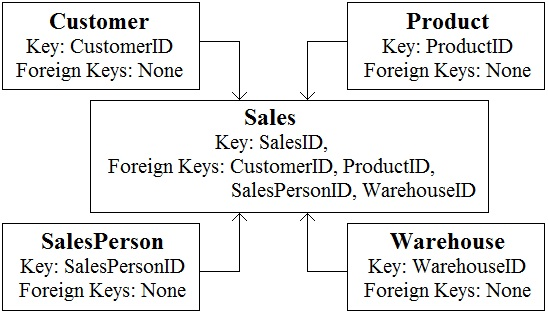
          Use the drop-down menus to select the answer choice that completes each statement based on the information presented in the graphic.
          NOTE: Each correct selection is worth one point
          Hot Area:
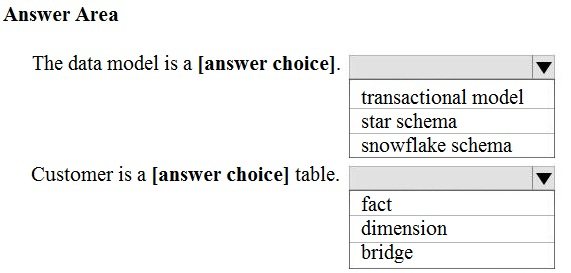
          Item 1

          1. AA. transactional model
          2. BB. star schema
          3. CC. snowflake schema

          Item 2

          1. AA. fact
          2. BB. dimension
          3. CC. bridge
          Show answer & explanation

          Correct answer: Item 1: B · Item 2: B
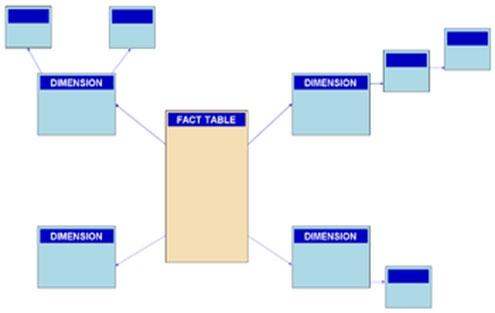
          ExplanationBox 1: star schema -
          In computing, the star schema is the simplest style of data mart schema and is the approach most widely used to develop data warehouses and dimensional data marts. The star schema consists of one or more fact tables referencing any number of dimension tables. The star schema is an important special case of the snowflake schema, and is more effective for handling simpler queries.
          Example:

          Incorrect Answers:
          The data in the question is not normalized.
          The snowflake schema is a variation of the star schema, featuring normalization of dimension tables. Example:

          Note: A snowflake schema is a logical arrangement of tables in a multidimensional database such that the entity relationship diagram resembles a snowflake shape. The snowflake schema is represented by centralized fact tables which are connected to multiple dimensions.[citation needed]. 'Snowflaking' is a method of normalizing the dimension tables in a star schema. When it is completely normalized along all the dimension tables, the resultant structure resembles a snowflake with the fact table in the middle.

          Box 2: dimension -
          The star schema consists of one or more fact tables referencing any number of dimension tables.
          Reference:
          https://docs.microsoft.com/en-us/azure/synapse-analytics/sql-data-warehouse/sql-data-warehouse-tables-overview https://en.wikipedia.org/wiki/Star_schema https://en.wikipedia.org/wiki/Snowflake_schema https://azure.microsoft.com/en-us/blog/data-models-within-azure-analysis-services-and-power-bi/

          QUESTION 9

          HOTSPOT -
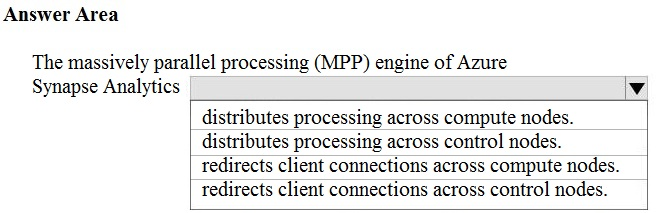
          To complete the sentence, select the appropriate option in the answer area.
          Hot Area:
            Show answer & explanation

            Correct answer: A

            ExplanationReference:
            https://docs.microsoft.com/en-us/azure/synapse-analytics/sql-data-warehouse/massively-parallel-processing-mpp-architecture

            QUESTION 10

            HOTSPOT -
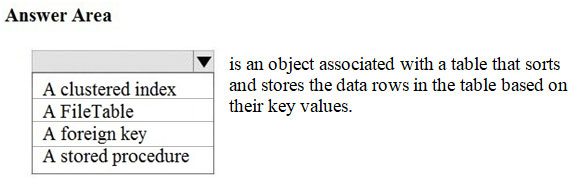
            To complete the sentence, select the appropriate option in the answer area.
            Hot Area:
              Show answer & explanation

              Correct answer: A

              ExplanationReference:
              https://docs.microsoft.com/en-us/sql/relational-databases/indexes/clustered-and-nonclustered-indexes-described?view=sql-server-ver15

              QUESTION 11

              HOTSPOT -
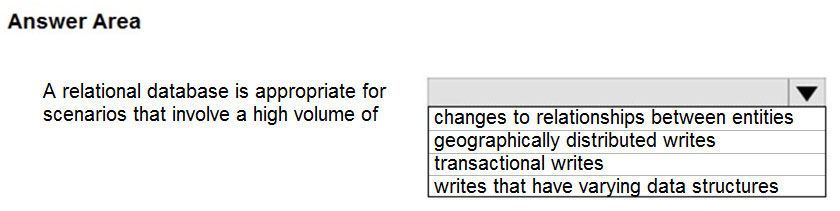
              To complete the sentence, select the appropriate option in the answer area.
              Hot Area:
                Show answer & explanation

                Correct answer: C

                ExplanationDisadvantages of non-relational databases include: Data Consistency ג€' non-relational databases do not perform ACID transactions.
                Note: Relational databases are optimized for writes. They are optimized for consistency and availability. Advantages of relational databases include simplicity, ease of data retrieval, data integrity, and flexibility.
                Incorrect Answers:
                Use a relational database when data that you work with is structured, and the structure is not subject to frequent changes.
                Use Cloud storage (no relational database) for geographically distributed writes.
                Reference:
                https://towardsdatascience.com/choosing-the-right-database-c45cd3a28f77

                QUESTION 12

                HOTSPOT -
                For each of the following statements, select Yes if the statement is true. Otherwise, select No.
                NOTE: Each correct selection is worth one point.
                Hot Area:
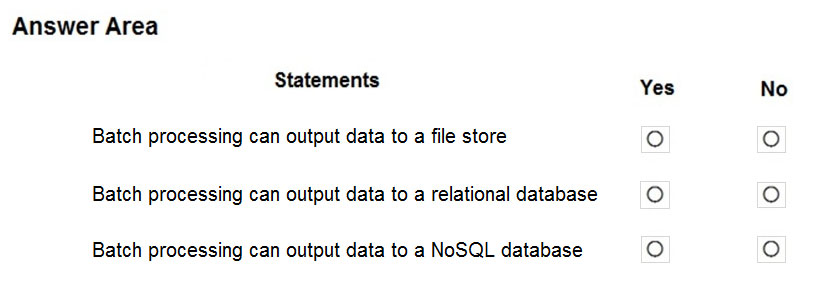
                1. ABatch processing can output data to a file store
                2. BBatch processing can output data to a relational database
                3. CBatch processing can output data to a NoSQL database
                Show answer & explanation

                Correct answer: Y, Y, Y

                ExplanationBatch processing can have output to SQL Database, Hive, HBase, Spark SQL. Look at the link and the diagram there https://docs.microsoft.com/en-us/azure/architecture/data-guide/big-data/batch-processing

                QUESTION 13

                DRAG DROP -
                Your company plans to load data from a customer relationship management (CRM) system to a data warehouse by using an extract, load, and transform (ELT) process.
                Where does data processing occur for each stage of the ELT process? To answer, drag the appropriate locations to the correct stages. Each location may be used once, more than once, or not at all. You may need to drag the split bar between panes or scroll to view content.
                NOTE: Each correct selection is worth one point.
                Select and Place:
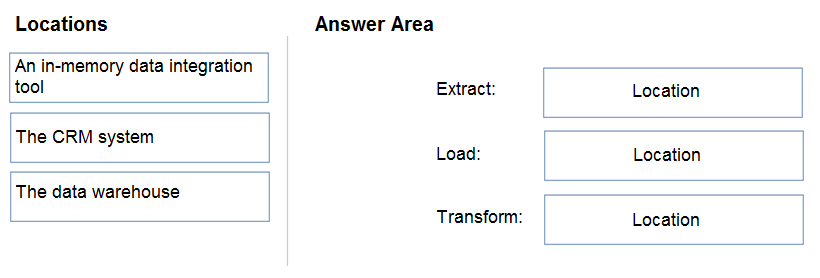
                Item 1

                1. AA. An in-memory data integration tool
                2. BB. The CRM system
                3. CC. The data warehouse

                Item 2

                1. AA. An in-memory data integration tool
                2. BB. The CRM system
                3. CC. The data warehouse

                Item 3

                1. AA. An in-memory data integration tool
                2. BB. The CRM system
                3. CC. The data warehouse
                Show answer & explanation

                Correct answer: Item 1: B · Item 2: C · Item 3: C

                Source explanation is not available for this question.

                QUESTION 14

                HOTSPOT -
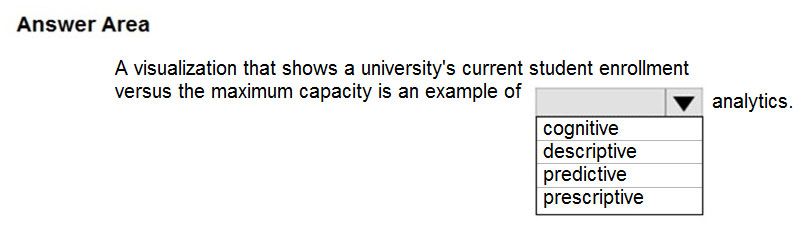
                To complete the sentence, select the appropriate option in the answer area.
                Hot Area:
                  Show answer & explanation

                  Correct answer: B

                  ExplanationGenerally speaking, data analytics comes in four types (Figure 1):
                  Descriptive, to answer the question: What's happening?
                  Diagnostic, to answer the question: Why's happening?
                  Predictive, to answer the question: What will happen?
                  Prescriptive, to answer the question: What actions should we take?
                  Reference:
                  https://azure.microsoft.com/en-us/blog/answering-whats-happening-whys-happening-and-what-will-happen-with-iot-analytics/

                  QUESTION 15

                  DRAG DROP -
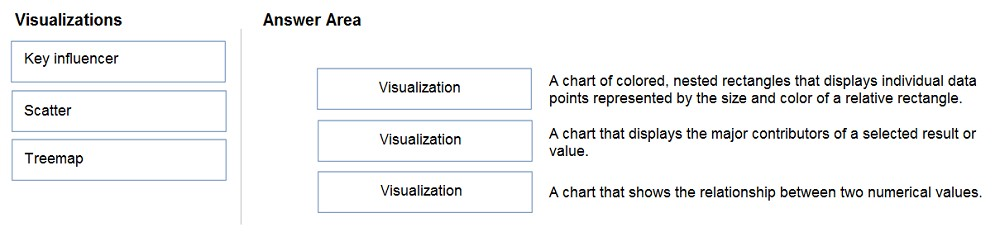
                  Match the types of visualizations to the appropriate descriptions.
                  To answer, drag the appropriate visualization type from the column on the left to its description on the right. Each visualization type may be used once, more than once, or not at all.
                  NOTE: Each correct match is worth one point.
                  Select and Place:
                  Item 1

                  1. AA. Key influencer
                  2. BB. Scatter
                  3. CC. Treemap

                  Item 2

                  1. AA. Key influencer
                  2. BB. Scatter
                  3. CC. Treemap

                  Item 3

                  1. AA. Key influencer
                  2. BB. Scatter
                  3. CC. Treemap
                  Show answer & explanation

                  Correct answer: Item 1: C · Item 2: A · Item 3: B
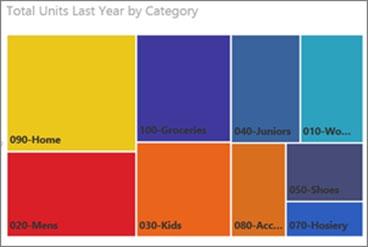
                  ExplanationBox 1: Tree map -
                  Treemaps are charts of colored rectangles, with size representing value. They can be hierarchical, with rectangles nested within the main rectangles.


                  Box 2: Key influencer -
                  A key influencer chart displays the major contributors to a selected result or value.

                  Box 3: Scatter -
                  Scatter and Bubble charts display relationships between 2 (scatter) or 3 (bubble) quantitative measures -- whether or not, in which order, etc.

                  QUESTION 16

                  You need to create an Azure Storage account.
                  Data in the account must replicate outside the Azure region automatically.
                  Which two types of replication can you use for the storage account? Each correct answer presents a complete solution.
                  NOTE: Each correct selection is worth one point.

                  1. AA. zone-redundant storage (ZRS)
                  2. BB. read-access geo-redundant storage (RA-GRS)
                  3. CC. locally-redundant storage (LRS)
                  4. DD. geo-redundant storage (GRS)
                  Show answer & explanation

                  Correct answer: B, D

                  ExplanationD: Azure Storage offers two options for copying your data to a secondary region:
                  ✑ Geo-redundant storage (GRS)
                  ✑ Geo-zone-redundant storage (GZRS)
                  B: With GRS or GZRS, the data in the secondary region isn't available for read or write access unless there is a failover to the secondary region. For read access to the secondary region, configure your storage account to use read-access geo-redundant storage (RA-GRS) or read-access geo-zone-redundant storage (RA-
                  GZRS).
                  Reference:
                  https://docs.microsoft.com/en-us/azure/storage/common/storage-redundancy#redundancy-in-a-secondary-region

                  QUESTION 17

                  HOTSPOT -
                  For each of the following statements, select Yes if the statement is true. Otherwise, select No.
                  NOTE: Each correct selection is worth one point.
                  Hot Area:
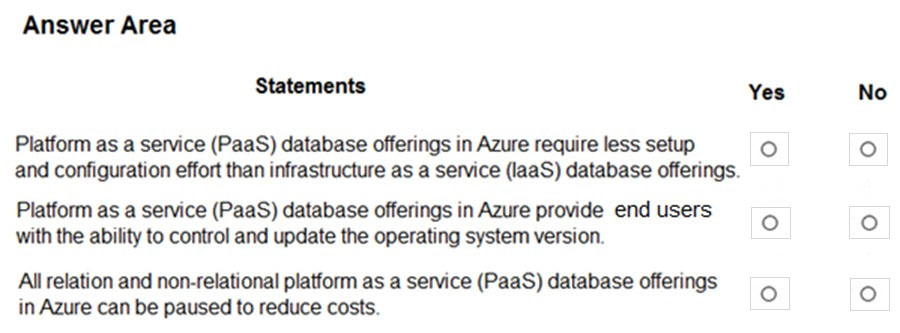
                  1. APlatform as a service (PaaS) database offerings in Azure require less setup and configuration effort than infrastructure as a service (IaaS) database offerings.
                  2. BPlatform as a service (PaaS) database offerings in Azure provide end users with the ability to control and update the operating system version.
                  3. CAll relation and non-relational platform as a service (PaaS) database offerings in Azure can be paused to reduce costs.
                  Show answer & explanation

                  Correct answer: Y, N, N

                  ExplanationBox 1: Yes -
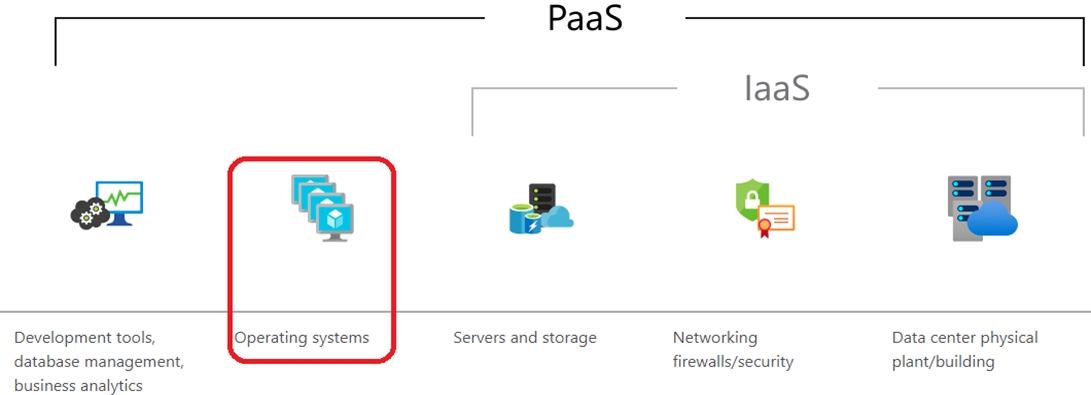
                  Like IaaS, PaaS includes infrastructure ג€' servers, storage, and networking ג€' but also middleware, development tools, business intelligence (BI) services, database management systems, and more. PaaS is designed to support the complete web application lifecycle: building, testing, deploying, managing, and updating.
                  PaaS allows you to avoid the expense and complexity of buying and managing software licenses, the underlying application infrastructure and middleware, container orchestrators such as Kubernetes, or the development tools and other resources

                  Box 2: No -
                  You manage the applications and services you develop, and the cloud service provider typically manages everything else.


                  Box 3: No -
                  There really is no way to pause / stop billing for your Azure SQL Database.
                  Microsoft's official answer 'Yes, you can export your database. Delete the Azure SQL database and that will pause billing. Then when you need it you can create a new database and import your previously exported DB.'
                  Reference:
                  https://azure.microsoft.com/en-us/overview/what-is-paas

                  QUESTION 18

                  Which statement is an example of Data Manipulation Language (DML)?

                  1. AA. REVOKE
                  2. BB. DISABLE
                  3. CC. INSERT
                  4. DD. GRANT
                  Show answer & explanation

                  Correct answer: C

                  ExplanationData Manipulation Language (DML) affect the information stored in the database. Use these statements to insert, update, and change the rows in the database.

                  BULK INSERT -

                  ✑ DELETE
                  ✑ INSERT
                  ✑ SELECT
                  ✑ UPDATE
                  ✑ MERGE
                  Reference:
                  https://docs.microsoft.com/en-us/sql/t-sql/statements/statements

                  QUESTION 19

                  You have a SQL query that combines customer data and order data. The query includes calculated columns.
                  You need to create a database object that would allow other users to rerun the same SQL query.
                  What should you create?

                  1. AA. an index
                  2. BB. a view
                  3. CC. a scalar function
                  4. DD. a table
                  Show answer & explanation

                  Correct answer: B

                  ExplanationA view is a virtual table whose contents are defined by a query. A view acts as a filter on the underlying tables referenced in the view. The query that defines the view can be from one or more tables or from other views in the current or other databases.
                  Reference:
                  https://docs.microsoft.com/en-us/sql/relational-databases/views/views

                  QUESTION 20

                  HOTSPOT -
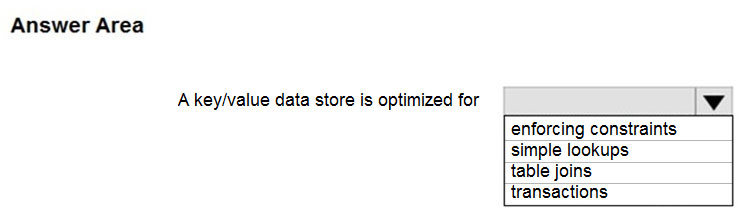
                  To complete the sentence, select the appropriate option in the answer area.
                  Hot Area:
                    Show answer & explanation

                    Correct answer: B

                    ExplanationBox 1: simple lookups -
                    A key/value store associates each data value with a unique key. Most key/value stores only support simple query, insert, and delete operations. To modify a value
                    (either partially or completely), an application must overwrite the existing data for the entire value. In most implementations, reading or writing a single value is an atomic operation.
                    An application can store arbitrary data as a set of values. Any schema information must be provided by the application. The key/value store simply retrieves or stores the value by key.
                    Reference:
                    https://docs.microsoft.com/en-us/azure/architecture/guide/technology-choices/data-store-overview

                    Build a focused DP-900 practice routine.

                    Choose DP-900 in Revizo and work through original, question-by-question practice on your iPhone. Review results, revisit what needs attention and keep your next session tied to one specific certification objective.

                    Practise DP-900 with Revizo

                    DP-900 practice questions.

                    Is Revizo the official Microsoft exam?

                    No. Revizo is an independent iPhone app for certification practice. Refer to the provider's official resources for current exam policies and registration.

                    How should I use these DP-900 practice questions?

                    Use the exam code to select the matching certification in Revizo, then build short, focused sessions around the areas you want to review.

                    Are Revizo questions copied from live examinations?

                    No. Revizo provides original practice questions for certification study. Use the provider's official objectives, documentation and policies as the source of truth for your preparation.

                    What should I use alongside DP-900 practice questions?

                    Use the current Microsoft objectives, documentation and registration guidance as your source of truth. Revizo is designed to support focused practice, not replace the provider's official materials.

                    Where can I confirm current DP-900 requirements?

                    Check the official Microsoft exam page for the latest objectives, registration details and policies.